Platform
Services
AI-Assisted digital forensics, compromise assessments, and continuous assurance that uncover hidden threats and deliver defensible, executive-ready insights.
AI-native security designed to scale, adapt, and iterate as enterprise AI evolves.
Anthropic launched Project Glasswing with twelve founding partners, Cisco among them, after a frontier model autonomously discovered zero-day vulnerabilities across major operating systems and browsers (Anthropic, 2026)
of breaches began with stolen or compromised credentials, the highest of any initial access vector (Verizon DBIR, 2025)
average time to identify and contain a credential-based breach (IBM Cost of a Data Breach, 2025)
Typical roi
reduction in security incident response time
reduction in compliance audit preparation time
limit on breach propagation through network segmentation
Time to value
Readiness assessment complete, with blast-radius baseline and TrustSec capability report
Proof of value running in monitor mode, showing real traffic before any policy is enforced
First enforcement zones live in production, campus or data center
From first assessment to ongoing operations. Pick the entry point that matches
where you are today.
A structured review of your access layer, identity sources, firewall estate, and data center visibility, with an automated TrustSec readiness report that shows exactly what is ready to enforce today.
For organizations:
A scoped lab or pilot that proves the design against success criteria you set up front, in monitor mode, before a single policy is enforced.
For organizations:
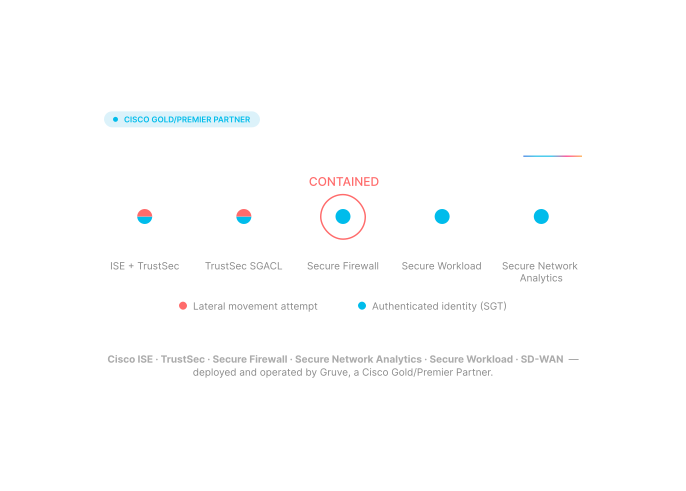
Identity-driven segmentation across the campus, built on Cisco ISE, TrustSec, Secure Firewall, and Secure Network Analytics, with SD-WAN carrying policy across the WAN.
For organizations
Workload-level segmentation with Cisco Secure Workload, mapped from observed behavior and simulated before enforcement, across bare metal, virtual machines, containers, and cloud.
For organizations
Ongoing, expert-led operation of your segmentation estate: policy lifecycle, drift control, vulnerability shielding, and reporting, so the model you paid to build keeps working.
For organizations
"Enterprises need secure AI infrastructure that is simple to deploy,
trusted, and easy to manage from day one. Our work with Gruve brings
assurance directly into the PulseAI Platform, so enterprises can move
fast without compromising on governance or control."
One accountable partner from first assessment to signed design to steady-state operations, backed by Gruve's global delivery model.
Identity, boundary, visibility, and workload enforcement under one policy model: ISE, TrustSec, Secure Firewall, Secure Network Analytics, Secure Workload, and SD-WAN.
Our IDA readiness assessment turns manual segmentation discovery into a one-click report, mapping your network devices against the Cisco Group Based Policy matrix to show exactly what is ready to enforce.
Every engagement shows real traffic and simulates policy before anything is blocked. No guesswork, no surprise outages.
SGT policy follows the user and the workload across campus, WAN, and data center, with no VLAN re-architecture and no re-IP.
Professional services for the build, managed segmentation for the life of the estate, and Cisco Capital financing available for fixed-scope programs.
limit on breach propagation
Deployments delivered across 100,000+ global locations.
No. Security Group Tags are assigned at authentication and travel with the user or device, so policy is written against identity rather than subnet. That is the main reason TrustSec-based segmentation can be phased into an existing network instead of requiring a re-architecture.
That is exactly what the readiness assessment establishes. The automated report maps your installed base against the Cisco Group Based Policy matrix and shows which platforms can enforce today, which need a software update, and which need to be sequenced into a refresh. Enforcement is phased around that reality, and boundary enforcement through Secure Firewall covers zones the fabric cannot yet enforce.
Most organizations start where the pressure is. If the driver is ransomware containment, IoT and OT exposure, or an ISE and firewall refresh already in flight, campus first. If the driver is a regulated application, PCI scope reduction, or crown jewel isolation, data center first. The policy model is shared either way, so neither path is wasted work.
Nothing is enforced until it has been observed. Secure Workload builds a dependency map from live telemetry and simulates policy against real traffic, and campus policy runs in monitor mode before SGACLs are enforced. The proof of value engagement exists specifically to prove this on your own environment.
An SGT policy matrix that maps to Zero Trust control requirements, a blast-radius baseline from the assessment, and, under managed segmentation, monthly containment and compliance reporting. Segmentation also narrows audit scope by isolating cardholder and regulated environments from the rest of the estate.
In many cases, yes. Cisco Live Protect applies a vulnerability shield to a live system with no downtime and no switch reboot, so devices are protected during the window between disclosure and your planned patch. Shields are continuously re-validated and retire automatically once the underlying software is patched.
Start with a segmentation readiness assessment, delivered jointly with Cisco.
You get a blast-radius baseline, an automated TrustSec readiness report, and a prioritized roadmap.