Just Launched Gruve PulseAI Platform, your private AI infrastructure, production-ready in under 2 weeks.PulseAI is live — private AI, ready in 2 weeks.

See PulseAI
The Gap

Your plan exists.
Has anyone practiced running it? 

Written, but
never rehearsed 

The plan exists. The rehearsed ability to declare, escalate, and coordinate under pressure usually doesn't. 

Ambiguous seams
between teams 

Security, Legal, and Communications each know their own piece, but handoffs and timing between them are where delay and exposure take hold. 

Rising regulatory
pressure  

SEC disclosure timelines, NYDFS, and HHS guidance all expect tested, drilled plans, not static documents. 

Not sure your escalation ownership would hold up under pressure?

Talk to a facilitator
Solutions

Turn a written plan
into a rehearsed capability 

A facilitator-led scenario tailored to your threat profile and regulatory context, testing the
connective tissue between Security, IT, Legal, HR, Communications, and executive
leadership, not just the technical workflow. 

Scenario design aligned
to your IR plan 

Built around your actual plan, operating environment, and likely threats, not generic theory. 

Cross-functional
decision validation 

Tests how Security, IT, Legal, HR, Communications, and leadership hand off and decide under pressure. 

Decision-forcing
facilitator injects 

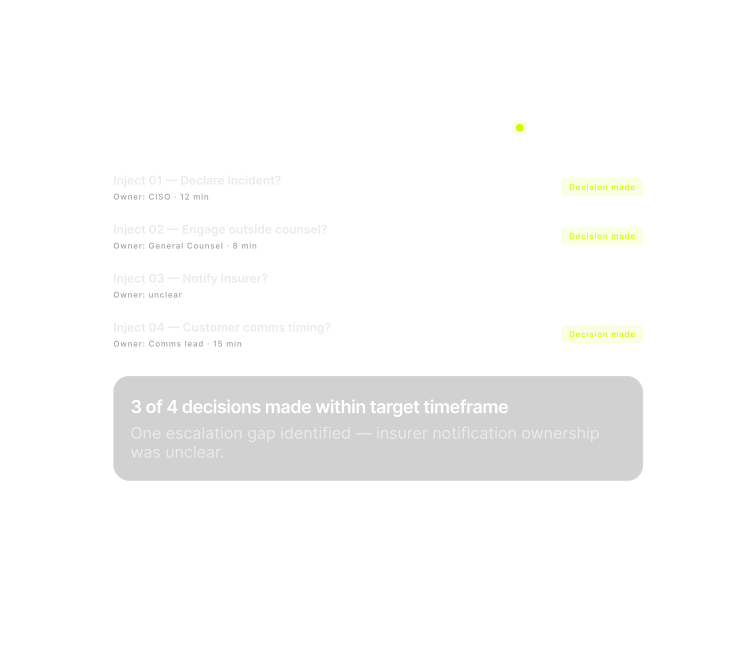
Every inject demands a real decision with a named owner and timeframe, no decision becomes a finding. 

AI-assisted
exercise support 

AI accelerates scenario branching and note capture; facilitators and DFIR leads own every conclusion. 

After-action reporting &
remediation roadmap 

Evidence-based gap analysis tied to specific injects, suitable for governance, audit, and insurance. 

Built by
DFIR practitioners 

Designed by people who’ve run real incidents, not generic workshop facilitators. 

HOW THE ENGAGEMENT WORKS 

Four phases,
from intake to after-action

Phase 1

Pre-session intake 

Define objectives and regulatory context. Review the current IR plan and map decision authority. 

Phase 2

Scenario configuration 

A structured platform generates a scenario mapped to the cross-functional decisions you'll need to make. 

Phase 3

Live session 

A time-compressed, facilitator-led session. Injects force real decisions; facilitators observe and log gaps. 

Phase 4

Post-session 

Evidence-based gap analysis tied to specific injects, plus a leadership readout with a remediation roadmap. 

DISTINCT SERVICE OFFERINGS 

Choose the scope that
fits your organization 

Tier 1

Core IR plan
readiness tabletop 

Single-scenario validation of your current incident response plan and escalation model. 

  • After-action summary
  • Readiness gaps
  • Prioritized improvement actions
Best for: CISOs, IR leads, IT & Legal stakeholders. 
Tier 3

Sector / regulatory readiness tabletop

Tuned to industry-specific pressures, disclosure timing, patient safety, or regulated data handling. 

  • Sector-specific observations
  • Disclosure/escalation findings
  • Executive summary
Best for: regulated industries, General Counsel, compliance leadership. 
WHY GRUVE

A proving ground, not a workshop  

Decision-driven, not discussion-based

every inject forces a real decision with a named owner. No decision means a documented finding. 

Cross-functional by design

Legal, HR, Communications, and leadership sit alongside Security and IT, because real incidents require all of them to coordinate. 

Evidence-based findings

every AAR finding ties to a specific inject and observed behavior, defensible for audit and board conversations. 

AI-augmented, human-led

AI speeds up scenario variation and reporting; every readiness judgment stays human-authored. 

Successful Stories

Learn how Gruve drives impact

Regional healthcare provider

Turning a static plan into a rehearsed one, before renewal

A regional healthcare provider needed documented proof its IR plan was ready, for both cyber-insurance renewal and leadership oversight. Gruve ran a ransomware-and-third-party-disruption tabletop across Security, IT, Legal, Compliance, and Communications. 
Key results
  • Found 2 escalation-path gaps and 1 declaration threshold that would have delayed executives 
  • Clarified engagement timing for counsel, the insurer, and communications leadership 
  • Delivered a documented after-action report ready for insurance and governance conversations 

FAQs

Frequently asked questions about
Incident response plan readiness tabletop

What is an IR Plan Readiness Tabletop?

A facilitator-led exercise that runs your team through a realistic incident scenario to test whether your written IR plan actually works under pressure — across Security, Legal, HR, Communications, and leadership. 

Who needs to be in the room? 

Whoever would need to act during a real incident. Beyond Security and IT, that typically means Legal, HR, Communications, and executive sponsors — the tabletop tests the handoffs between them, not just one team’s workflow. 

Does AI run the exercise? 

No. AI helps generate scenario variations and speeds up note capture and reporting. Facilitators and DFIR leads control the session, and every finding and recommendation is human-authored. 

What happens if the team can't reach a decision? 

That’s documented as a finding, not smoothed over. Every inject requires a named owner, a timeframe, and a communication path — where that doesn’t happen, it becomes a gap in your after-action report. 

What do we walk away with? 

A structured after-action report with evidence-based gap analysis, a prioritized remediation roadmap, and an executive readout — output suitable for governance, audit, and insurance conversations. 

Get Started

Turn your incident response plan into a
practiced response capability

See how Gruve's Incident Response Plan Readiness Tabletop helps your teams validate escalation,
coordination, and decision-making before the real incident arrives. 

    Response within 24 hours · NDA available on request