Just Launched Gruve PulseAI Platform, your private AI infrastructure, production-ready in under 2 weeks.PulseAI is live — private AI, ready in 2 weeks.

See PulseAI
Why Now

Attackers can linger quietly,
or move faster than your
alerts can react. 

Note: the following are third-party industry statistics used to frame the
problem — not Gruve's own results. 

11 days

global median attacker dwell time (Mandiant M-Trends, 2025) 

72 mins

fastest observed time from initial access to data exfiltration (Palo Alto Networks Unit 42, 2025) 

44%

increase in attacks starting with exploitation of public-facing applications (IBM X-Force, 2025) 

The Gap

Strong tooling doesn't
guarantee nothing is hiding

Controls catch what they're tuned to catch 

Sophisticated adversaries don't always trip existing detections, real compromise often spans identity, cloud, SaaS, endpoint, and admin behavior before it looks like anything. 

Attackers are getting harder to predict 

AI-assisted workflows let adversaries run reconnaissance and initial access across hundreds of targets in parallel, while some intrusions reach exfiltration in barely over an hour. 

Every change opens a new question 

New vulnerabilities, identity-platform shifts, SaaS expansion, and executive onboarding all create fresh reasons to hunt for specific behavior before it becomes an incident. 

"Most tools tell you what they were built to catch. Threat hunting exists to answer the harder question, is something already inside that hasn't tripped anything yet?" 

Talk to an investigator
Solutions

What the engagement delivers 

Threat-informed, hypothesis-driven hunts built around your current risk picture,
not an outsourced alert queue, and not a generic one-size-fits-all package. 

Threat-informed
hunt hypotheses 

Builds the hunt around real adversary behavior, current client concerns, and the specific technologies or workflows most likely to reveal hidden compromise. 

Multi-source
behavior analysis 

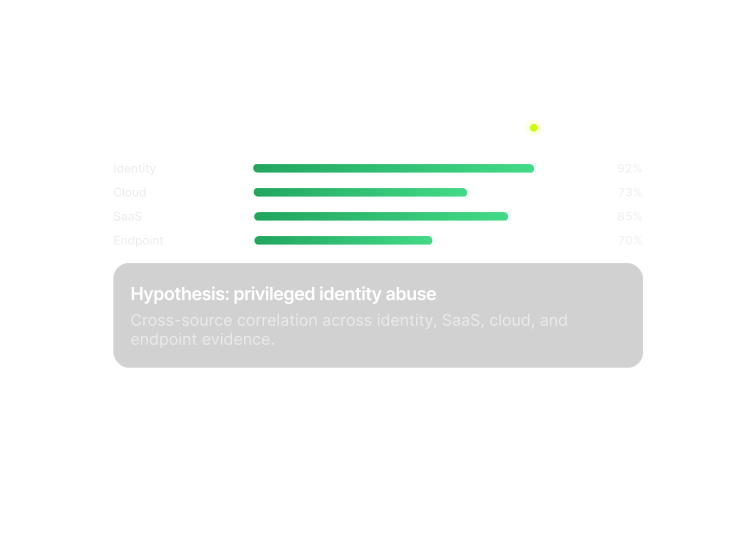
Correlates endpoint, identity, cloud, SaaS, and administrative evidence to test for suspicious activity beyond what the alerting layer has already surfaced. 

AI-teammate
assisted clustering 

Uses AI to accelerate organization of large evidence sets and candidate patterns, while every meaningful hunt decision and finding stays in human hands. 

Detection and
resilience gap analysis 

Documents where existing detections, logging, access controls, or response workflows failed to surface behavior that warranted attention. 

Executive and
operational reporting 

Delivers both the hunt conclusion and the concrete improvements needed to reduce future blind spots — whether or not active compromise is found. 

BENEFITS

What your team
gets out of it 

Tests for adversary behavior that may not cleanly match pre-existing alerts, signature logic, or workflow assumptions. 

Improves the odds of finding threats earlier by looking deliberately in the places and patterns most likely to be missed. 

Turns hunt results into concrete improvements for logging, alerting, identity controls, and cross-domain visibility. 

Focuses scarce analyst attention on hypotheses tied to current threats, technology changes, and business-critical assets.  

Gives leaders a clearer sense of whether hidden attacker activity has been actively tested for, rather than merely assumed absent. 

DISTINCT SERVICE OFFERINGS 

Three ways to bring Gruve in

Intelligence-led

Intelligence-led threat hunt 

A hypothesis-driven hunt based on current adversary activity, threat intelligence, or industry-relevant campaign patterns. 

  • Threat hypothesis design
  • Telemetry review
  • Adversary-pattern testing
  • Reporting 
Best for: CISOs · Detection engineering · Threat intelligence teams
Post-exposure

Post-change / post-exposure hunt 

Targeted hunting after major platform changes, emerging CVEs, vendor notices, or control disruptions that may create short-term blind spots. 

  • Change-aware hypothesis development
  • Focused searches
  • Anomaly validation
  • Resilience recommendations
Best for: IR leaders · Cloud teams · Platform owners 
WHY GRUVE

Hunting that's guided by human
judgment, accelerated by AI 

Threat-informed, not tool-driven 

Hypothesis-driven hunts built around real adversary behavior — not purely telemetry-driven or tool-driven. 

Works across hybrid evidence 

Identity, SaaS, cloud, and endpoint context brought together in a single hunt narrative. 

AI accelerates, humans decide 

AI speeds up the hunt workflow without ever deciding what counts as compromise. 

Value even without a finding 

Produces detection and resilience improvements even when the hunt doesn’t surface active compromise. 

Fits your existing program 

Slots naturally into post-exposure validation, executive assurance, or a recurring resilience cadence. 

Successful Stories

Multinational manufacturer 

From sector-wide concern to a defensible answer 

A multinational manufacturer asked Gruve to hunt for signs of adversary activity after a widely exploited edge technology vulnerability was disclosed and several industry peers reported follow-on identity abuse. There was no declared incident, but leadership needed to know whether the exposed technology had become a beachhead into identity systems, privileged SaaS access, or sensitive engineering environments — and the existing detections weren't built to answer that specific question. 
Key results
  • Identified suspicious identity and administrative behaviors that hadn't generated high-confidence internal alerts 
  • Helped rule out broad destructive or ransomware activity while still acting on meaningful exposure indicators 
  • Improved detection logic and monitoring priorities for the specific attack pattern relevant to the client 
  • Delivered a defensible threat-hunt narrative for leadership during a sector-wide risk event 

FAQs

Frequently asked questions about
Threat hunting

Is this just an outsourced alert queue? 

No. Each engagement is scoped around specific business and threat questions, not generic alert triage — and executed across whichever data sources matter most for answering them. 

Do we need a declared incident to start a hunt? 

No. Threat hunting is proactive by design — it’s built for situations like a new vulnerability disclosure, sector-wide risk signals, or organizational change, before anything is confirmed. 

Does AI decide what counts as suspicious? 

No. AI accelerates clustering, prioritization, and hypothesis development, but human analysts decide what to test, how to pivot, and which anomalies are meaningful. 

What if the hunt doesn't find active compromise? 

That’s still a valuable outcome. Every engagement concludes with concrete detection and resilience improvements, whether or not compromise is found. 

How is this different from our internal SOC checking the same telemetry? 

Internal teams know the environment, but rarely have the dedicated time, threat-informed structure, and independent challenge function needed for disciplined hunting beyond day-to-day alert handling. Gruve brings that as a focused, time-boxed engagement. 

Get Started

Don't wait for an alert,
go find out for sure

See how Gruve's Threat Hunting engagement helps your team test for hidden adversary activity,
reduce blind spots, and improve resilience with evidence-backed conclusions.

    Response within 24 hours · NDA available on request