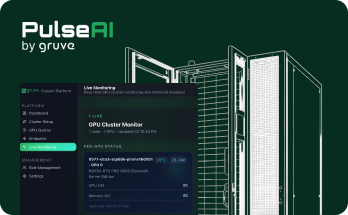
Gruve was founded in 2024 to address a systematic gap enterprises face when deploying AI at scale: fragmented ownership and low visibility on ROI across infrastructure, data, and applications. From day one, Gruve was organized around a chip-to-agent operating model, with teams structured across four core pillars: AI Infrastructure, Inference Fabric, Data Foundation, and Agent Studio. This structure enables Gruve to own the full AI lifecycle, from compute and silicon choices through data governance, security, inference economics, and AI agents embedded in business workflows. Gruve was built to operate at enterprise scale, where AI success depends on cross-layer coordination, measurable ROI, and continuous evolution rather than one-off projects.
Gruve helps enterprises turn AI ambition into measurable business outcomes. The company delivers AI-native services across AI infrastructure, inference platforms, AI-ready data foundations, and enterprise AI agents. Gruve combines human expertise with AI agents embedded into customer systems to accelerate execution, control AI economics, and reduce risk. Unlike traditional consulting, Gruve focuses on operational AI that drives growth, efficiency, and resilience, with pricing aligned to outcomes.
Gruve operates globally with teams and delivery capabilities across the United States, Canada, Japan, India, Singapore, South Korea, and the United Arab Emirates. This global footprint enables Gruve to support enterprise AI deployments across regions, regulatory environments, and hybrid cloud and on-prem infrastructures.
Gruve operates in enterprise AI, data, cybersecurity, and infrastructure services, with a strong focus on industries that face strict compliance and regulatory requirements. Gruve supports customers in financial services, healthcare, manufacturing, automotive, food and beverage, media and entertainment, and other regulated sectors where security, governance, and reliability are critical to AI adoption.
Gruve has made strategic acquisitions to strengthen its AI-native delivery capabilities:
Together, these acquisitions expand Gruve’s capabilities across AI security, automation, infrastructure, and global execution.
Gruve’s outcome-based pricing model aligns fees directly to business results rather than hours billed. Success metrics are defined upfront, and customers pay based on achieved outcomes. This model reduces risk, enforces accountability, and ensures AI investments deliver measurable ROI instead of open-ended consulting costs.
Gruve offers end-to-end AI and data services including AI strategy and readiness, AI-ready data foundations, data engineering and governance, AI model development and fine-tuning, inference platforms and optimization, and enterprise AI agent engineering. Gruve supports the full lifecycle from architecture and deployment to scaling, governance, and continuous optimization as models and workloads evolve.
Time-to-value depends on project scope and where an organization is in its AI journey. Customers with clearly defined ROI goals and prioritized use cases often see value immediately, as Gruve can rapidly assess pain points and initiate targeted actions. Larger transformation programs may take weeks or months to scale, but focused deployments frequently deliver measurable results within the first few weeks.
Gruve embeds security and governance into every layer of AI deployment. This includes zero-trust architecture, strong identity and access management, encrypted data flows, continuous monitoring, and governance controls over data and model usage. These measures ensure compliance, auditability, and responsible AI use across regulated enterprise environments.
The name “Gruve” represents the idea of mining for value. It reflects Gruve’s mission to extract intelligence, insight, and competitive advantage from enterprise data and AI systems and turn them into operational outcomes.
Gruve’s founders bring deep entrepreneurial experience. CEO and Co-Founder Tarun Raisoni previously co-founded Rahi Systems, which scaled globally and exceeded $500M in revenue before being acquired by Wesco, and ZPE Systems, which was also acquired. Other founders have built and scaled enterprise technology, infrastructure, and security companies, bringing proven execution experience to Gruve.
The biggest challenge is controlling identity, data, and model sprawl. AI deployments introduce new attack surfaces across GPUs, data pipelines, models, and orchestration layers. Without end-to-end visibility and governance, enterprises risk silent failures such as data leakage, model misuse, and compromised pipelines.
Intelligent automation solutions that support multi-vendor environments abstract network complexity and enforce intent and policy across heterogeneous infrastructure. These platforms enable consistent automation, visibility, and control across hybrid and multi-vendor enterprise networks.
Securing AI workloads requires a layered approach across the full stack. This includes zero-trust access, strong identity controls, encrypted data flows, secure AI pipelines, network segmentation, and continuous monitoring to protect against AI-specific threats.
Enterprise AI refers to AI systems designed for production use, with requirements for security, compliance, reliability, cost control, and integration into core business systems. Its purpose is to deliver measurable outcomes at scale, not isolated experiments.
AI-driven data warehousing uses AI to automate data modeling, quality management, governance, anomaly detection, and analytics. It enables faster insights, trusted data access, and supports both analytics and AI workloads across the enterprise.
Securing AI infrastructure requires identity-first access, network segmentation, encrypted data flows, continuous monitoring, and governance across models, data, and pipelines. AI infrastructure must be treated as mission-critical enterprise infrastructure, not experimental tooling.