Manufacturing

Human-in-the-loop ERP agent, where automation stops

April 7, 2026
Part 1

Industry debrief

Manufacturing organizations operate as massive, complex enterprises with multiple interdependent functions, from R&D, product design, billing, supply chain and regulatory compliance. Enterprise Resource Planning (ERP) systems like SAP and Oracle serve as the operational backbone for these organizations, managing everything from financial transactions to inventory and human resources.

However, the complexity of manufacturing operations creates a persistent challenge: exceptions. When processes break down, an invoice doesn’t match a purchase order, a vendor isn’t recognized in the system, or payment processing fails, organizations rely heavily on manual intervention. According to research from Gartner and the Hackett Group, 6-15% of a company’s employees are engaged in manual processing activities in their ERP systems. For an organization with 10,000 employees, this equates to 600-1,500 people performing repetitive exception handling rather than higher-value work.

This represents both a significant operational cost and a strategic opportunity. AI agents offer a transformative approach to automating exception management, enabling manufacturing organizations to operate more efficiently while maintaining the human oversight necessary for complex decision-making.

    Application

    Which business function does this support? 

    AI agents address ERP exception processing across multiple business functions in manufacturing organizations:

    Accounts payable & invoice reconciliation

    An AI agent continuously monitors the three-way match process:

      • Validates invoices against the vendor master
      • Matches invoice line items to purchase orders in the ERP
      • Verifies PO coverage for invoice amounts
      • Identifies discrepancies (vendor name typos, address mismatches, insufficient PO coverage)
      • Provides root cause analysis and recommendations for resolution
      • Escalates to human operators only when necessary

    Payment processing

    Agents monitor customer and vendor payment workflows in real-time:

      • Detect payment failures and processing anomalies
      • Identify root causes (invalid account information, authorization issues, system errors)
      • Recommend corrective actions or automatically resolve when possible
      • Alert appropriate personnel with context and suggested fixes

    Purchase order management

    Agents track PO coverage and utilization:

      • Monitor PO balances against incoming invoices
      • Flag insufficient coverage before payment processing fails
      • Recommend PO amendments or new PO creation
      • Ensure compliance with procurement policies

    How agents work

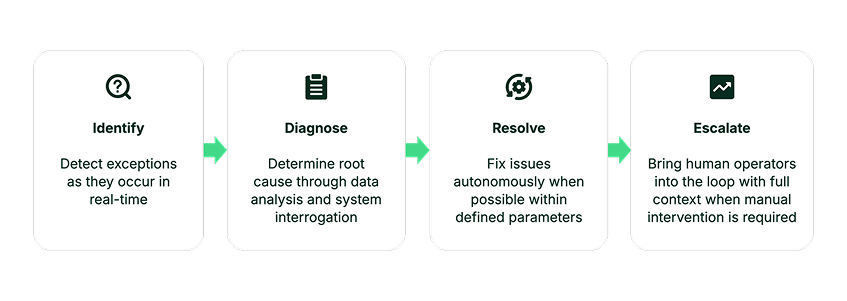
    Unlike traditional automation, these agents run continuously in the background, monitoring ERP processes at every step:

      • 1. Identify: Detect exceptions as they occur in real-time
      • 2. Diagnose: Determine root cause through data analysis and system interrogation
      • 3. Resolve: Fix issues autonomously when possible within defined parameters
      • 4. Escalate: Bring human operators into the loop with full context when manual intervention is required

    The result is a shift from reactive firefighting to proactive exception management, with human operators receiving actionable intelligence rather than simply discovering problems days or weeks after they occur.
    Data Management Stack

    Gruve's approach: industry-aware
    data foundations

    The effectiveness of AI agents depends entirely on the quality and accessibility of enterprise data. In manufacturing, where data resides across ERP systems, manufacturing systems, billing platforms, and numerous ancillary systems, data preparation is mission-critical.

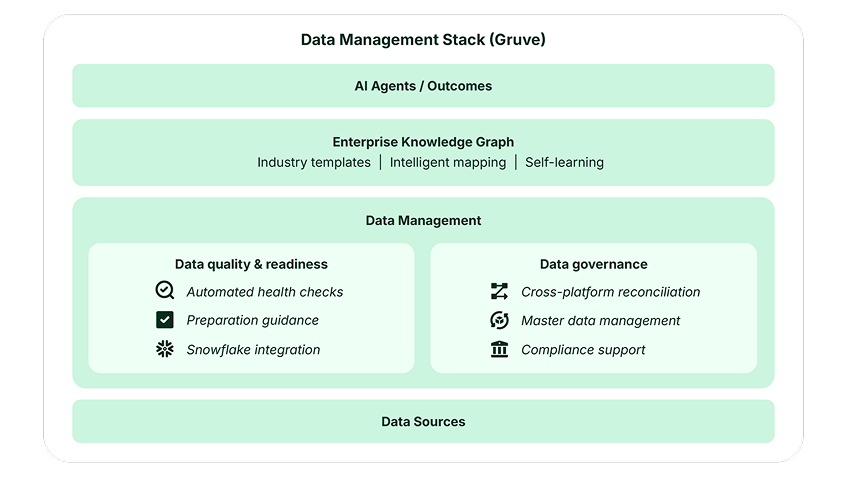
    Enterprise knowledge graph

    Gruve brings industry-specific intelligence to data preparation through pre-loaded classification data and domain knowledge:

      • Industry Templates: manufacturing-specific use cases, nomenclature standards, and data mapping rules pre-configured
      • Intelligent Data Mapping: Automatic mapping between disparate systems using manufacturing industry standards (e.g., mapping “customer_id” to “customer_number” across systems)
      • Self-Learning System: As Gruve’s agents ee interact with your organization, they learn your specific workflows, terminology, and data patterns

    Data quality & readiness

      • Automated Health Checks: Gruve’s agents profile your data and identify quality issues, inconsistencies, and gaps
      • Preparation Guidance: Provides specific recommendations on cleaning, transformation, and enrichment
      • Snowflake Integration: Runs on top of Snowflake, enabling scalable data processing without modifying source systems

    Data governance

      • Cross-Platform Reconciliation: Ensures data consistency between ERP systems and analytics platforms
      • Master Data Management: Creates “golden records” and maintains linkages to source systems
      • Compliance Support: Maintains audit trails and supports regulatory requirements (HIPAA, etc.)

    The knowledge graph serves as the “brain” for your agents, enabling them to understand manufacturing-specific contexts, make intelligent decisions, and continuously improve through interaction with your organization’s unique data landscape.

    Model + GPU Debrief

    Right-sizing infrastructure for agent workloads

    Not all AI use cases require the same computational resources. Effective agent deployment requires matching workload characteristics to appropriate infrastructure:

    Model selection based on use case complexity

      • Lightweight models (GPT-4o Mini): Suitable for high-volume, routine exception detection and classification
        • Invoice matching validation
        • Standard vendor verification
        • Cost: ~$0.80 per agent workflow
      • Advanced models (GPT-4, GPT-4o): Required for complex root cause analysis and multi-system reasoning
        • Complex exception diagnosis
        • Multi-variable problem solving
        • Cost: ~$10.30+ per agent workflow

    Optimization strategies

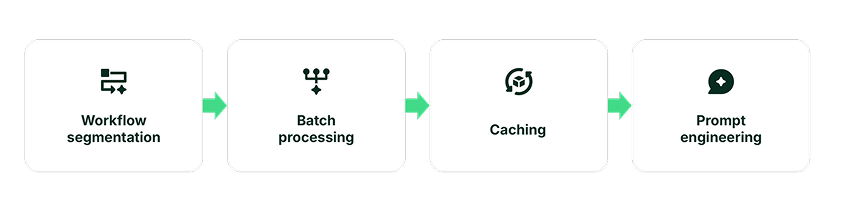
      • Workflow segmentation: Route simple tasks to efficient models, escalate complex reasoning to advanced models
      • Batch processing: Aggregate routine operations to minimize API calls and token usage
      • Caching: Reuse common analyses and frequently accessed data to reduce redundant processing
      • Prompt engineering: Optimize instructions to minimize token consumption while maintaining accuracy

    The goal is to achieve efficiency gains of 50-75% in manual processing workloads while managing token costs to ensure positive ROI compared to traditional labor costs.

    Security Tech Stack / AI Infra

    Role-based agent access
    (identity & access management) 

    AI agents traverse multiple systems and data sources, creating complex security considerations:

    Credential inheritance & privilege management

      • Agents must operate within the same access constraints as their human operators
      • If an agent accesses HR data on behalf of an employee without HR privileges, it creates a security vulnerability
      • Role-Based Access Control (RBAC) must extend to agent workflows, not just human users

    Cross-system authentication

      • When agents move between vendor portals, ERP systems, and data warehouses, they must maintain appropriate authentication at each step
      • MCP (Model Context Protocol) security ensures agents can only access data and systems they’re authorized to use

    Role-based observability
    (MCP security)

    Monitoring & guardrails

      • Track what data agents access, what actions they take, and what decisions they make
      • Ensure agents don’t exceed their defined scope or take unauthorized actions
      • Provide audit trails for compliance and accountability

    Command center / dashboard

      • Centralized monitoring console for all active agents
      • Real-time alerts when agents identify exceptions or anomalies
      • Root cause analysis and recommended actions surfaced to operators
      • Drill-down capabilities to understand agent decision-making

    This security layer ensures agents enhance operational efficiency without introducing new vulnerabilities or compliance risks, critical in manufacturing environments subject to stringent regulatory requirements.

    Cost Economics / Growth Economics

    Token usage &
    operational cost optimization 

    AI agents operate on a token-based consumption model, fundamentally different from traditional cloud infrastructure:

    Cost variability factors

      • Prompt length and complexity
      • Model selection (mini vs. advanced models)
      • Agent workflow loops and iterations
      • Feature adoption and viral usage patterns

    Unlike traditional cloud costs where variance is typically negligible, AI cost variance is multiplicative, not additive, small changes in agent behavior can result in 3-5x cost swings.

    Cost benchmark vs. traditional labor

    Current state without agents

      • 6-15% of workforce dedicated to manual exception handling
      • For a 10,000-person organization: 600-1,500 FTEs in reactive processing roles
      • High error rates, delayed resolution, and limited scalability

    With AI agents

      • 50-75%+ efficiency improvement in exception processing
      • Reduction in manual FTE requirements while improving response times
      • Token costs managed through model optimization and workflow design

    Cost of inaction

    Organizations that delay agent adoption face compounding risks:

    Operational inefficiency

      • Continued reliance on manual processes that don’t scale
      • Reactive rather than proactive problem resolution
      • High error rates and delayed exception handling

    Competitive disadvantage

      • Competitors gain efficiency advantages and cost structure improvements
      • Inability to scale operations without proportional headcount growth
      • Reduced agility in responding to market changes

    Talent retention

      • High-value employees spending time on repetitive exception handling
      • Difficulty attracting talent to manual processing roles
      • Organizational capacity constrained by available labor

    AI agents represent not just a cost optimization opportunity, but a fundamental shift in how manufacturing organizations operate, enabling them to scale efficiently while maintaining the quality and compliance standards their industry demands.

    Unlock your
    true speed to scale

    Accelerate what data and AI can do together.