Check all thoughts
Blog
The next frontier of automation: from playbooks to autonomous AIOps
June 10, 2026

Automation is a core requirement for digital transformation. But the automation conversation has changed.
For years, organizations focused on building playbooks, automating repeatable tasks, and reducing manual effort across infrastructure, network, security, and operations. That work still matters. In fact, the automation built over the past several years remains fundamental to operational excellence.
But the environment around it has changed.
AI agents have moved from future vision to operational reality, running in production, handling real workflows, and making real decisions. Complexity is increasing, systems are more interconnected, and business expectations are rising. Staffing constraints remain real, and security and compliance demands are only growing. At the same time, AI has fundamentally changed the economics of operations, shifting the question from “can we afford to?” to “can we afford not to?”
AI may reduce the cost of creating code, but it increases the volume of code to manage, the complexity across the stack, and the cost of inference. In the AI infrastructure era, tokenomics becomes part of the operating model.
That raises a practical question for every enterprise: why spend tokens and GPU cycles on basic deterministic infrastructure tasks?
The right model matches the pattern to the problem. Deterministic tasks should run through trusted automation. Real-time signals should flow through event-driven response. AI should be used where reasoning, context, prioritization, and decision support create real value.
This is why enterprise automation maturity matters. Without a trusted execution layer, AI remains insight without action. Without governance, the blast radius of an AI mistake may be difficult to understand until it is too late. Mission-critical infrastructure cannot be an experiment. It demands deterministic behavior, trusted execution, clear policy boundaries, and complete auditability.
Red Hat Ansible Automation Platform becomes critical in this model. It is more than a playbook execution engine. It becomes the governed execution layer that allows enterprises to automate with control today and prepare for AI-driven operations tomorrow.
That is the opportunity Gruve helps enterprises capture: moving from isolated automation efforts to a governed operating model built for speed, scale, cost efficiency, and intelligent execution.
The trap: declaring victory too early
Automation programs often lose momentum after the first visible win. A team builds playbooks for patching. Another automates network configuration. Another creates reusable workflows for VM lifecycle tasks. These are good and necessary outcomes. They prove that automation can reduce manual effort, standardize execution, and improve operational consistency.
But too often, the enterprise declares victory too early and moves on to the next critical priority.
The playbooks exist, but humans still decide when to run them, why to run them, who should approve them, and what should happen next. The automation is real, but the operating model is still manual.
This is the hidden constraint inside many IT organizations. They do not lack tools. They lack a unifying model that turns automation into operational leverage.
At Gruve, we see the path forward as three connected modes: task-driven operations, event-driven operations, and AI-driven operations. Each mode builds on the one before it.
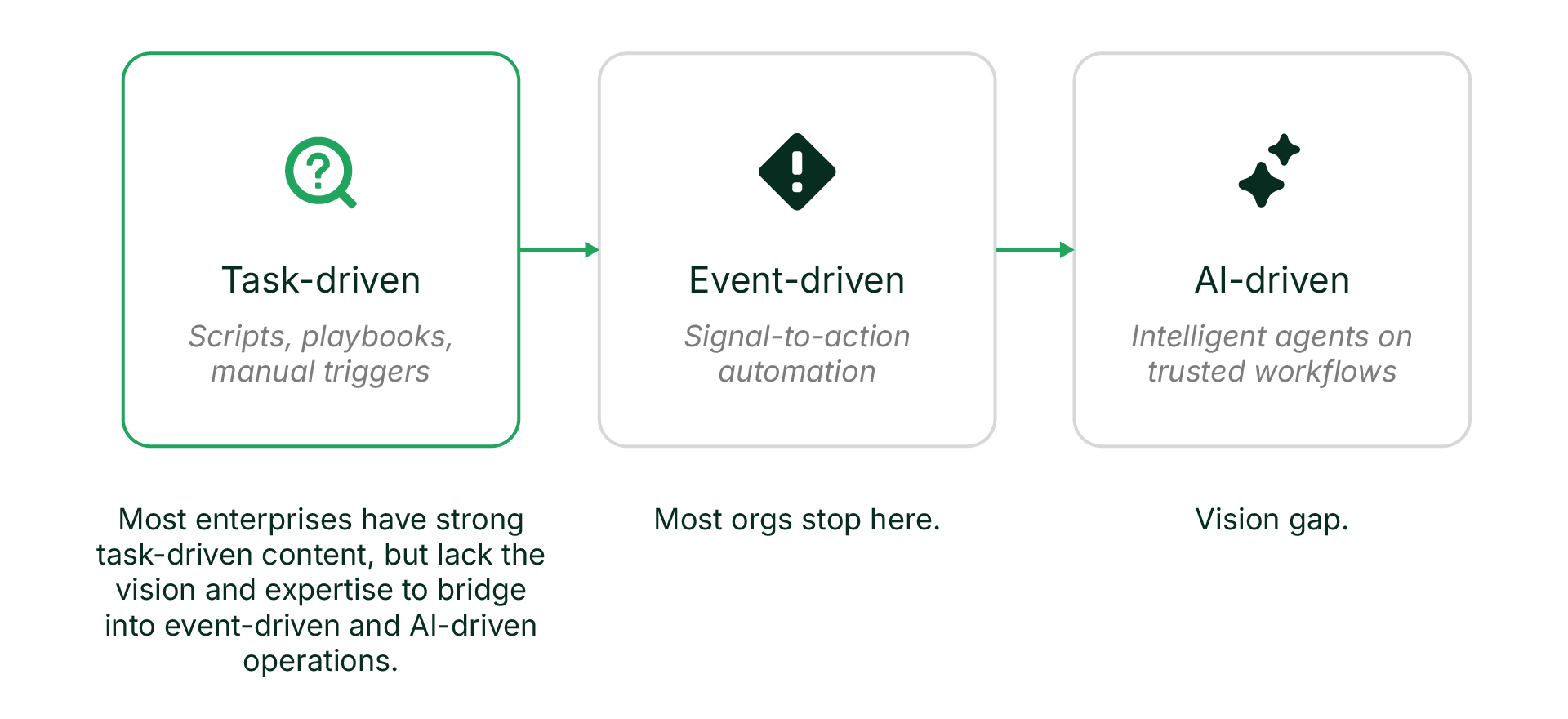
Task-driven operations
Build the automation foundation
Everything starts with a trusted execution foundation. Before an organization can scale event-driven response or AI-assisted operations, it needs reliable automation, governed workflows, clean operational data, and the right AI capabilities embedded into the operating model.
Task-driven operations turn manual knowledge into trusted automation. This is not just about writing playbooks. It is about taking repeatable operational work and turning it into structured, reusable, governed content.
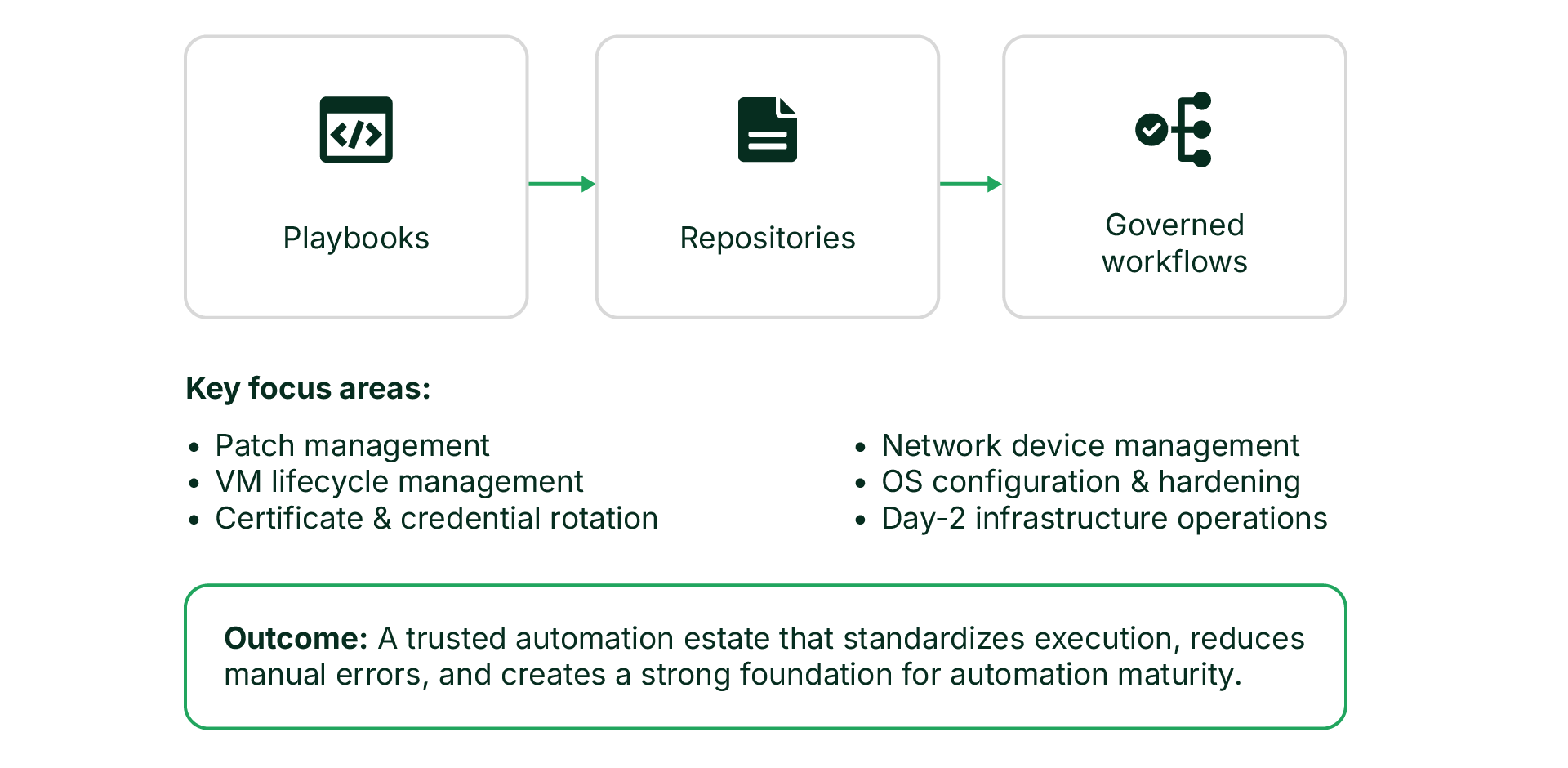
The maturity path is simple: build playbooks, organize them in repositories, and promote the right automation into governed workflows.
Gruve helps organizations build this foundation by identifying the right operational use cases, standardizing automation content, organizing repositories, and turning repeatable tasks into governed workflows inside Red Hat Ansible Automation Platform.
The focus areas are familiar: patch management, VM lifecycle management, certificate and credential rotation, network device management, OS configuration and hardening, and day-2 infrastructure operations.
The outcome is a trusted automation estate that standardizes execution, reduces manual error, and creates the foundation for enterprise automation maturity.
This foundation becomes even more valuable in the AI era. Every approved playbook expands the library of safe actions an AI agent can recommend or invoke. Every policy and access control creates a governance boundary. Every automated use case strengthens the audit trail across the operational stack. These returns compound.
Event-driven operations
Connect signal to action
Once trusted automation exists, the next question is clear: what should trigger it?
A playbook sitting in a repository does not reduce MTTR by itself. If a human still has to notice the alert, open the ticket, gather facts, choose the workflow, and coordinate the response, the enterprise is still constrained by manual coordination.
Event-driven operations close that gap.
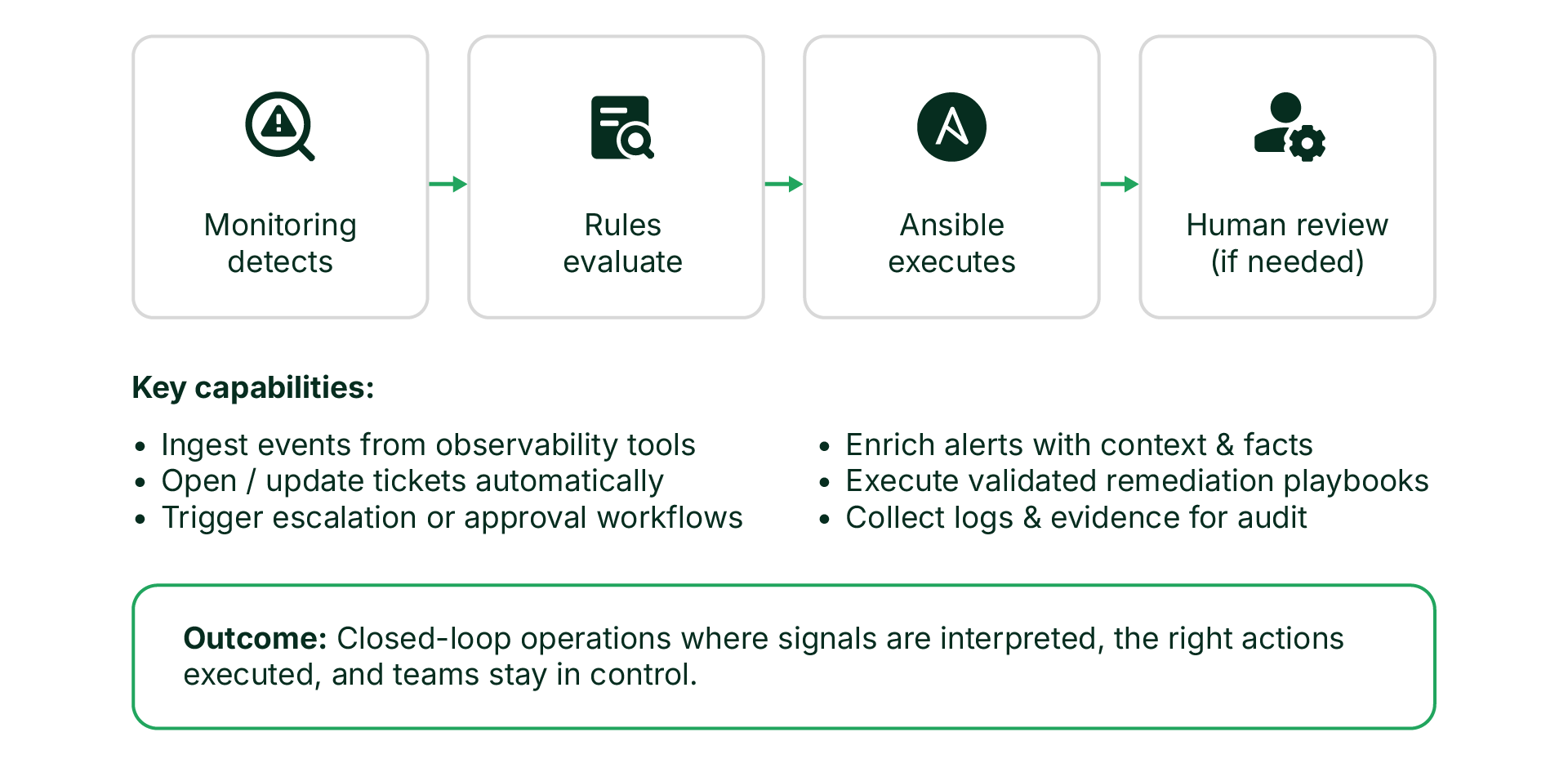
Monitoring detects. Rules evaluate. Ansible executes. Humans review when needed.
This is where automation moves from content to capability. Signals from monitoring, observability, ITSM, security, infrastructure, and applications can trigger the right response automatically. That response may include opening or updating tickets, enriching alerts with context, collecting evidence, escalating for approval, or executing validated remediation playbooks.
Gruve helps organizations build this layer by connecting monitoring and ITSM platforms to Event-Driven Ansible, defining event rules, mapping alerts to approved workflows, building escalation paths, and ensuring every automated response remains governed, auditable, and controlled.
This is where governance must be established before the agents arrive. The policies, access controls, approvals, and audit trails built through Ansible Automation Platform define what can run, who can run it, when it can run, and how every action is recorded.
AI-driven operations
Intelligence over a trusted control plane
And then comes the question every leadership team is now asking: Where does AI fit?
The wrong answer is to place an AI agent on top of an unstable operating model and expect intelligence to fix disorder. It will not. AI does not compensate for poor execution design. It amplifies the system it is placed into.
If automation is fragmented, ungoverned, or disconnected from operational signals, AI creates faster confusion. But when the foundation is in place, AI becomes a force multiplier. This is where AI-driven operations become more than assisted troubleshooting.
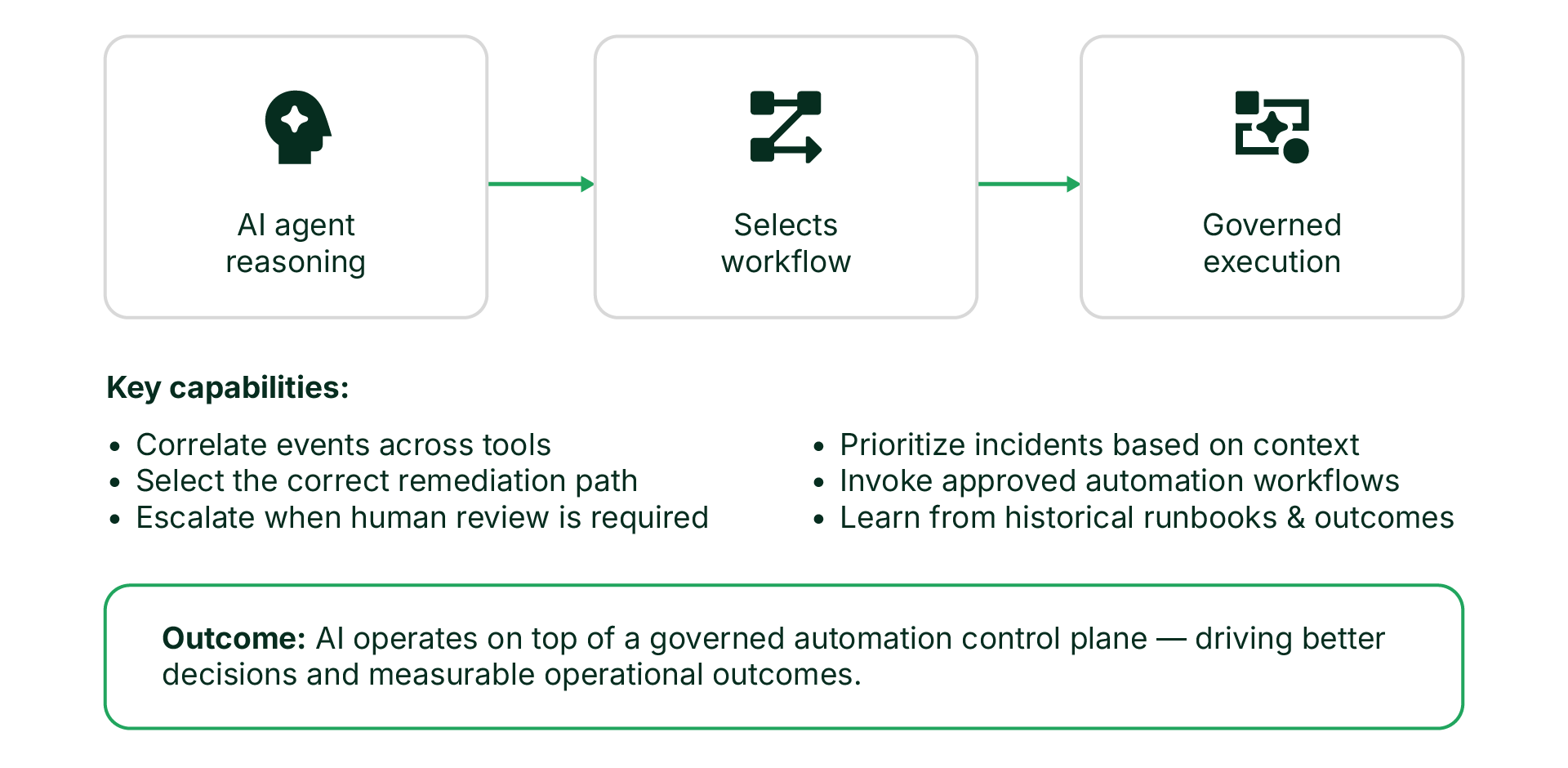
AI agents need three things to operate safely: a library of approved actions, execution boundaries defined before they run, and an audit trail that proves what happened, when it happened, and why.
That is how Gruve approaches AI-driven operations. Gruve does not start with an agent and work backward. Gruve helps organizations mature through task-driven and event-driven operations first, then extends that trusted control plane with agentic capabilities.
Gruve Autonomous AIOps provides reasoning and context. Red Hat Ansible Automation Platform provides governed execution. Together, they combine intelligent decisions with deterministic, trusted outcomes.
This is where AI-driven operations become more than assisted troubleshooting. The vision is an AI layer that can reason across telemetry, vulnerability data, compliance scans, and operational history to identify where new event-driven responses are needed. For example, if OpenSCAP detects a critical vulnerability across managed infrastructure, AI can correlate affected assets with exposure and business criticality, recommend a new alert pattern, and map it to an approved ansible remediation workflow with the right approvals and audit trail.
The goal is not to replace operational discipline. The goal is to extend it with intelligence that operates within trusted boundaries.
One connected automation framework
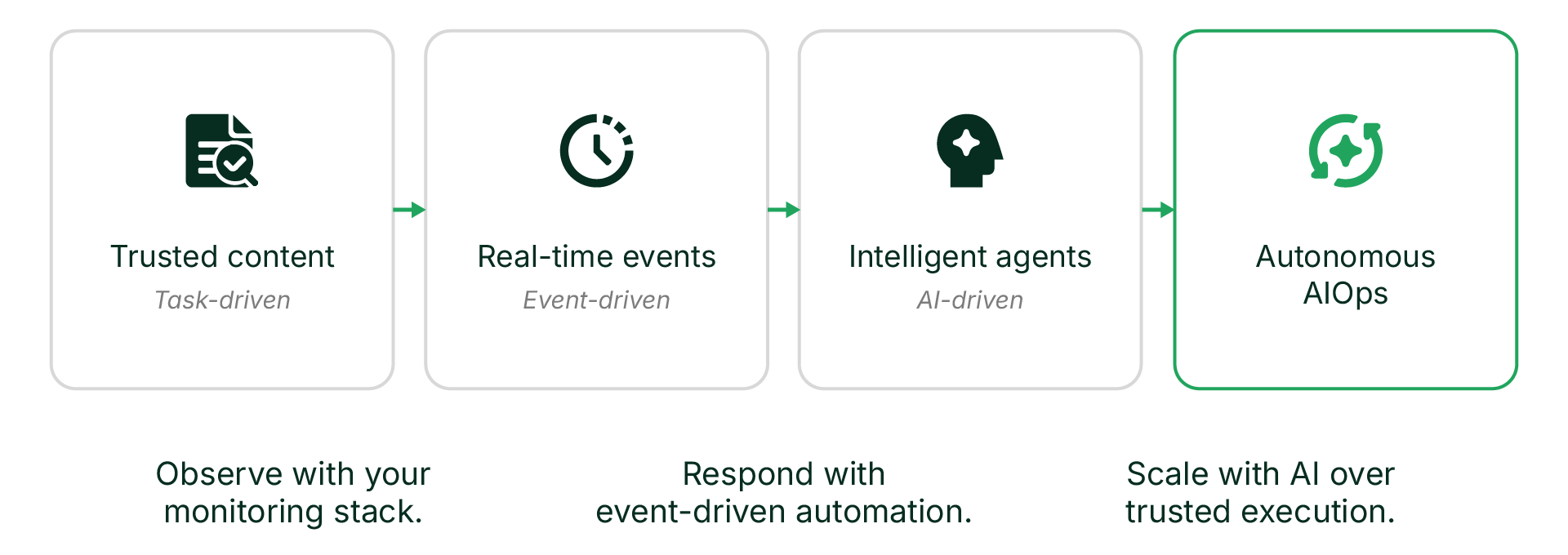
Winning the next era of operations isn’t about automating more. It’s about building an integrated system that can observe, interpret, and act with both speed and control. Task-driven automation creates the approved action library. Event-driven automation connects signals to response. AI-driven operations add intelligence over a trusted control plane.
These are not separate workstreams. They are one execution model.
With Red Hat Ansible Automation Platform, Gruve helps enterprises move beyond isolated automation and build a mature automation operating model that is governed, scalable, cost-aware, and ready for AI-driven operations.
The future is not AI replacing operations.
The future is AI reasoning over trusted automation, real-time signals activating governed workflows, and enterprises executing with confidence across mission-critical infrastructure.