Manufacturing organizations operate as massive, complex enterprises with multiple interdependent functions, from R&D, product design, billing, supply chain and regulatory compliance. Enterprise Resource Planning (ERP) systems like SAP and Oracle serve as the operational backbone for these organizations, managing everything from financial transactions to inventory and human resources.
However, the complexity of manufacturing operations creates a persistent challenge: exceptions. When processes break down, an invoice doesn’t match a purchase order, a vendor isn’t recognized in the system, or payment processing fails, organizations rely heavily on manual intervention. According to research from Gartner and the Hackett Group, 6-15% of a company’s employees are engaged in manual processing activities in their ERP systems. For an organization with 10,000 employees, this equates to 600-1,500 people performing repetitive exception handling rather than higher-value work.
This represents both a significant operational cost and a strategic opportunity. AI agents offer a transformative approach to automating exception management, enabling manufacturing organizations to operate more efficiently while maintaining the human oversight necessary for complex decision-making.
AI agents address ERP exception processing across multiple business functions in manufacturing organizations:
An AI agent continuously monitors the three-way match process:
Agents monitor customer and vendor payment workflows in real-time:
Agents track PO coverage and utilization:
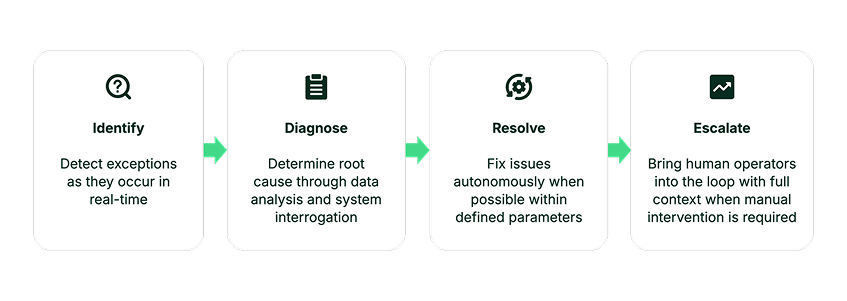
Unlike traditional automation, these agents run continuously in the background, monitoring ERP processes at every step:
The result is a shift from reactive firefighting to proactive exception management, with human operators receiving actionable intelligence rather than simply discovering problems days or weeks after they occur.
The effectiveness of AI agents depends entirely on the quality and accessibility of enterprise data. In manufacturing, where data resides across ERP systems, manufacturing systems, billing platforms, and numerous ancillary systems, data preparation is mission-critical.
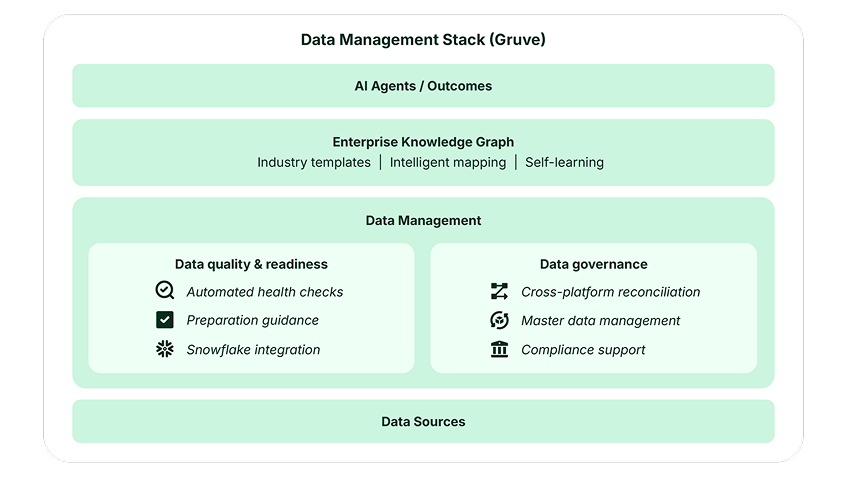
Gruve brings industry-specific intelligence to data preparation through pre-loaded classification data and domain knowledge:
The knowledge graph serves as the “brain” for your agents, enabling them to understand manufacturing-specific contexts, make intelligent decisions, and continuously improve through interaction with your organization’s unique data landscape.
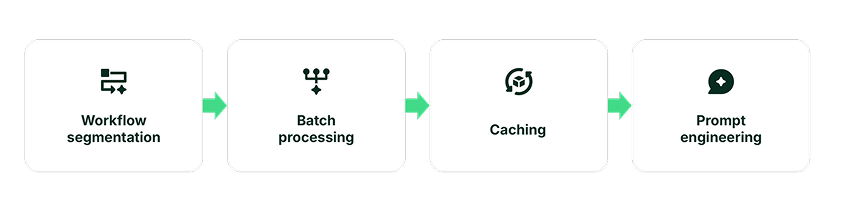
Not all AI use cases require the same computational resources. Effective agent deployment requires matching workload characteristics to appropriate infrastructure:
The goal is to achieve efficiency gains of 50-75% in manual processing workloads while managing token costs to ensure positive ROI compared to traditional labor costs.
AI agents traverse multiple systems and data sources, creating complex security considerations:
This security layer ensures agents enhance operational efficiency without introducing new vulnerabilities or compliance risks, critical in manufacturing environments subject to stringent regulatory requirements.
AI agents operate on a token-based consumption model, fundamentally different from traditional cloud infrastructure:
Unlike traditional cloud costs where variance is typically negligible, AI cost variance is multiplicative, not additive, small changes in agent behavior can result in 3-5x cost swings.
Organizations that delay agent adoption face compounding risks:
AI agents represent not just a cost optimization opportunity, but a fundamental shift in how manufacturing organizations operate, enabling them to scale efficiently while maintaining the quality and compliance standards their industry demands.