The Problem

Are you deploying AI
without knowing if your security can protect it?

Organizations rush to adopt AI across business functions — yet most deploy without assessing
whether their cybersecurity controls can protect AI-specific attack surfaces, secure sensitive
training data, or prevent model theft and manipulation. The consequences are severe: breaches
through AI systems carry average costs of $4.45M, with healthcare and financial services exceeding $10M. 

01

Insecure
AI deployment

Leadership approves AI initiatives without understanding whether existing security controls adequately protect AI systems, creating blind spots adversaries actively exploit.

02

Sensitive
data exposure

AI systems process vast amounts of PII, intellectual property, financial data, and healthcare records. Breaches through AI carry average costs of $4.45M.

03

Model theft and
manipulation

Model theft enables competitors to replicate years of R&D investment. Prompt injection attacks manipulate AI into bypassing controls or leaking information.

04

Regulatory blind spots

EU AI Act, GDPR, CCPA, HIPAA, SEC rules, and NIS2 Directive create AI security obligations most organizations haven’t addressed.

05

AI supply chain risks

Third-party AI vendors, open-source models, and AI API providers introduce supply chain attack vectors traditional security frameworks don’t assess.

$4.45M average breach cost through AI systems — with healthcare and financial services breaches exceeding $10M. Most organizations deploy AI without assessing whether their security can handle AI-specific threats.

Why Now

Why AI security assessment can’t wait

We deliver a complete transformation of your SOC by integrating AI agents that perform
analyst duties across the entire lifecycle. 

Threats have moved from theoretical to actively exploited

Adversaries steal proprietary AI models through API exploitation. Malicious actors poison training datasets. Real-world breaches involving AI systems increase quarterly. 

Regulations are now active requirements

The EU AI Act became enforceable with substantial penalties. Industry regulators (OCC, FDA, FTC) issued AI-specific security guidance. Non-compliance triggers enforcement actions and fines. 

The window for proactive assessment is closing

Organizations conducting readiness assessments now can incorporate proper controls before regulatory examinations or incidents force expensive retrofitting. Those waiting face 10–100x higher remediation costs. 

Competitive dynamics reward secure AI deployment

Organizations demonstrating robust AI security gain customer trust, pass reviews faster, and avoid breach-related disruptions. 

10–100x

higher remediation costs for those who wait until after breaches or enforcement actions force expensive retrofitting, reputational damage, and regulatory penalties.

What We assess

What our AI cybersecurity readiness
assessment covers

Gruve’s AI cybersecurity readiness assessment provides comprehensive evaluation of your
organization’s preparedness to securely deploy, operate, and govern AI systems enterprise-
wide. Our cybersecurity experts combine 17+ years of security operations experience
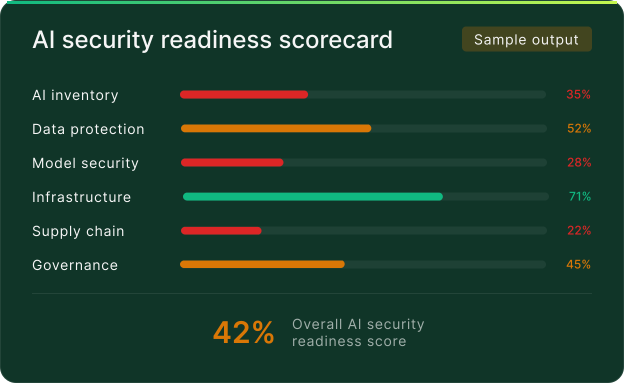
with cutting-edge AI security specialization to assess AI inventory, data protection controls,
model security practices, infrastructure hardening, supply chain risks, compliance frameworks,
and governance mechanisms. 

AI system inventory and classification

Comprehensive discovery of deployed AI systems including generative AI integrations, custom models, AI-embedded applications, and shadow AI usage. Risk classification based on data sensitivity, decision authority, and regulatory applicability.  

  • Inventory
  • Shadow AI
  • Risk classification

Data protection and privacy

Assessment of sensitive data handling in AI systems, training data security, inference data protection, data retention and disposal, privacy controls for PII/PHI/PCI, and data sovereignty compliance.

  • PII/PHI/PCI
  • Training data
  • Sovereignty

AI model security

Evaluation of model protection mechanisms, adversarial robustness, prompt injection defenses, model theft prevention, poisoning attack resistance, and output validation controls.

  • Adversarial
  • Prompt injection
  • Poisoning

Infrastructure and platform security

Review of AI hosting environment security, API authentication and authorization, network segmentation, secrets management, access controls, and cloud configuration security.

  • API security
  • Cloud config
  • Access controls

Supply chain risk

Assessment of third-party AI vendor security, open-source model risks, AI API provider security, dependency management, and supply chain attack vectors.

  • Vendor risk
  • Open-source
  • Dependencies

Governance and compliance

Evaluation of AI governance frameworks, decision accountability, audit trails, model explainability, regulatory compliance (EU AI Act, GDPR, sector-specific), and risk management integration.

  • EU AI Act
  • GDPR
  • Governance
Service tiers

Choose your
readiness assessment scope

Two engagement options, from focused risk identification to exhaustive enterprise-wide
readiness evaluation.

Foundation

Posture assessment

3-day engagement

$35,000 – $60,000

  • checkCritical systems inventory
  • checkHigh-risk vulnerability assessment
  • checkSample data protection assessment
  • checkCompliance gap highlights
  • check90-day action plan
Measurable results

Measurable outcomes from
readiness assessment

Risk identification and
quantification

Identify active vulnerabilities with risk quantification translating technical findings to business impact, breach probability, potential financial losses, and regulatory penalties.

Regulatory compliance
roadmap

Detailed compliance gap analysis and remediation roadmap for EU AI Act, GDPR, CCPA, HIPAA, and sector-specific requirements with audit-ready documentation.

Prevention of
AI breaches

Avoid $4.5M+ average breach costs through proactive vulnerability identification and remediation before adversaries exploit weaknesses.

Accelerated secure
AI adoption

Enable confident AI deployment with validated security controls rather than delaying initiatives due to security concerns.

Competitive
advantage

Demonstrate AI security leadership to customers, partners, and regulators, passing security reviews faster and building trust.

Why Gruve

Why choose Gruve for
cybersecurity readiness

17+ years of security
operations expertise

Our cybersecurity experts combine deep security operations experience with cutting-edge AI security specialization. We assess readiness across technical controls, operational processes, governance, and compliance.

Technology-agnostic
framework

Unlike vendor assessments biased toward specific products, Gruve delivers technology-agnostic evaluation covering all AI platforms, deployment models, and use cases.

Readiness,
not just posture 

Readiness assessment evaluates preparedness to securely adopt AI, covering controls, governance, and compliance before deployment. This complements posture assessment, which tests live systems post-deployment. Many organizations need both.

FAQs

Frequently asked questions about
AI cybersecurity readiness assessment

1. What is an AI cybersecurity readiness assessment?

An AI cybersecurity readiness assessment evaluates your organization’s preparedness to securely deploy, operate, and govern AI systems enterprise-wide. It examines whether your existing cybersecurity controls, governance frameworks, and compliance capabilities can adequately protect AI-specific attack surfaces, before deployment, not after a breach.

2. How is readiness assessment different from posture assessment?

Readiness assessment evaluates preparedness to securely adopt AI, covering controls, governance, and compliance frameworks before or during deployment. Posture assessment examines the security of AI systems already in production, identifying exploitable vulnerabilities in live systems. Many organizations need both: readiness first for new deployments, posture for existing systems.

3. What AI platforms and frameworks do you assess?

We are technology-agnostic and platform-independent. We assess readiness for AI built on any framework (TensorFlow, PyTorch, OpenAI, Anthropic, custom models), deployed on any cloud (AWS, Azure, GCP, on-premise), and covering any use case.

4. What compliance frameworks does the assessment cover?

EU AI Act, GDPR, CCPA, HIPAA, SEC cybersecurity disclosure rules, NIS2 Directive, and sector-specific requirements. We deliver audit-ready documentation and detailed compliance gap analysis.

5. Does the assessment cover AI supply chain risks?

Yes. Supply chain risk is a dedicated assessment dimension covering third-party AI vendor security, open-source model risks, AI API provider security, dependency management, and supply chain attack vectors.

6. How long does the assessment take and what does it cost?

Foundation: 3–5 days, $35,000–$60,000, covering critical systems with 90-day action plan. Comprehensive: 10 days, $90,000–$175,000, complete discovery including shadow AI with 12–18 month phased strategy.

Get Started

Secure your AI transformation
today

Don’t wait for a breach or regulatory enforcement to discover AI security gaps.
Request a readiness assessment to get a clear roadmap to secure AI
deployment. 

    Response within 24 hours · NDA available on request