The Problem

Are you deploying autonomous AI agents
without security assessment?

Autonomous AI agents make independent decisions, access critical infrastructure, execute actions
without human approval, and operate 24/7 without supervision. Yet most organizations deploy them
without rigorous security assessment, entrusting these systems with authorities that would require
extensive vetting for human employees. 

01

Excessive permissions

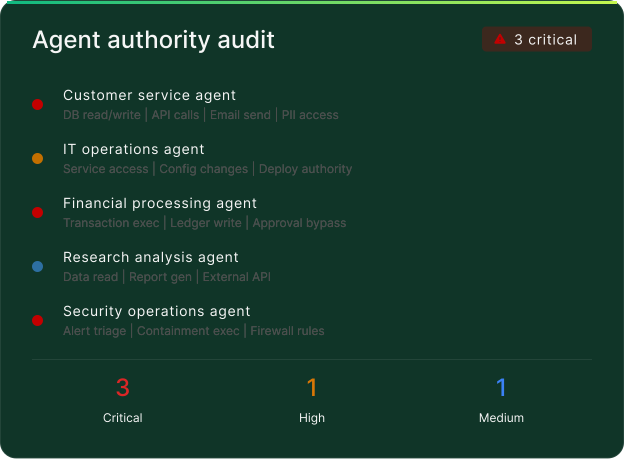
AI agents with excessive permissions can exfiltrate sensitive data, make unauthorized financial transactions, manipulate business systems, and bypass security controls, all autonomously beyond human oversight. 

02

Decision manipulation

Prompt injection attacks manipulate agent decision-making. Jailbreak techniques bypass safety controls. Goal hijacking redirects agent behavior toward adversary objectives. 

03

Tool poisoning attacks

Adversaries manipulate agent tool access, poisoning inputs, intercepting API calls, and exploiting credential chains to turn agents into attack vectors. 

04

Multi-agent
chain attacks

Multi-agent vulnerabilities enable chain attacks across interconnected agents. Compromising one agent can cascade through trust boundaries to breach entire ecosystems.

05

Regulatory high-risk
classification

The EU AI Act classifies many autonomous agents as high-risk AI systems requiring stringent security controls, human oversight, and accountability mechanisms. 

$4.45M average data breach cost, but AI agent breaches enabling prolonged unauthorized access to critical systems can cost tens of millions through data theft, fraud, and operational disruption.

Why Now

Why AI agent security can’t wait 

We deliver a complete transformation of your SOC by integrating AI agents that perform
analyst duties across the entire lifecycle. 

Adoption accelerating faster than security understanding

Organizations deploy agents without security assessment and discover vulnerabilities only after incidents, compliance violations, or operational failures. 

Real-world agent security incidents emerging

Adversaries demonstrate prompt injection manipulating agent actions. Researchers expose jailbreak bypasses. Most agent compromises go undetected or unreported. 

Regulatory enforcement transitioning to action

EU AI Act establishes explicit requirements for high-risk AI including autonomous agents. Regulators examine oversight, controls, and accountability. 

Pre-deployment fixes cost 10–100x less

Security designed into agent architecture requires minor effort. Retrofitting forces architectural rework, operational disruption, and business process shutdowns. 

10–100x

lower cost when fixing agent security issues pre-deployment vs post-deployment remediation. Security designed in beats security bolted on.

What We Cover

What our AI agent
security assessment covers

Gruve’s AI agent security assessment provides rapid, expert evaluation of autonomous AI agent
security through adversarial testing, threat modeling, and comprehensive security analysis.
We assess agent decision logic, tool access authorities, data handling, oversight mechanisms, and
multi-agent interactions, identifying vulnerabilities traditional penetration testing cannot detect

Agent threat modeling

Comprehensive analysis of agent attack surface including decision manipulation, tool poisoning, credential theft, privilege escalation, data exfiltration, and operational disruption scenarios with risk quantification.

  • Attack surface
  • Risk quantification

Decision logic security

Assessment of agent reasoning security including prompt injection vulnerabilities, jailbreak resistance, goal hijacking prevention, constraint bypass testing, and decision validation mechanisms.

  • Prompt injection
  • Goal hijacking
  • Jailbreak

Tool access security

Evaluation of agent permissions and authorities, least privilege compliance, tool authentication security, action authorization controls, dangerous capability restrictions, and audit trail completeness.

  • Permissions
  • Least privilege
  • Audit trail

Data protection assessment

Analysis of sensitive data handling in agent workflows, training data security, inference data protection, memory security, data leakage prevention, and privacy control validation.

  • Memory security
  • Data leakage
  • Privacy

Agent oversight mechanisms

Review of human oversight controls, decision escalation procedures, automatic safety limits, anomaly detection capabilities, kill switch mechanisms, and incident response integration.

  • Kill switch
  • Escalation
  • Safety limits

Multi-agent security

Assessment of agent-to-agent communication security, trust boundaries, chain attack prevention, coordinated action controls, and system-level security properties.

  • Chain attacks
  • Trust boundaries

Compliance framework

Evaluation against EU AI Act requirements for high-risk agents, NIST AI RMF alignment, industry regulations, audit trail adequacy, explainability capabilities, and accountability mechanisms.

  • EU AI Act
  • NIST AI RMF
  • High-risk
Service tiers

Choose your agent assessment
scope

Two engagement options, from focused priority agent testing to comprehensive multi-
agent ecosystem evaluation.

Foundation

Agent assessment

5-day engagement

$35,000 – $60,000

  • check2–3 priority agents assessed
  • checkCore vulnerability testing
  • checkHigh-level threat modeling
  • checkBasic multi-agent interaction analysis
  • checkCompliance gap highlights
  • check60-day action plan
Measurable results

Outcomes from
agent security assessment

Pre-deployment
risk mitigation

Identify and eliminate agent security vulnerabilities before production when remediation costs 10–100x less, preventing catastrophic security failures. 

Prevention of
agent breaches

Stop breaches through agent compromise ($4.45M+ avg), prevent unauthorized actions and fraud, block operational disruption, protect against model theft. 

Regulatory compliance
assurance 

Verify EU AI Act compliance for high-risk agents, validate human oversight, confirm audit trail completeness, demonstrate accountability mechanisms. 

Accelerated safe
deployment 

Enable confident agent deployment with validated security rather than delaying projects or deploying insecure agents creating risk. 

Stakeholder
confidence 

Security evidence satisfying executive concerns, passing customer reviews, meeting partner requirements, demonstrating due diligence to regulators. 

Why Gruve

Why choose Gruve 
for autonomous AI security

Agent-specific
security expertise 

Our specialists understand autonomous AI agent architecture — decision logic, tool access chains, permission models, and multi-agent interactions. We test what generic pen-test firms can’t even identify. 

All agent platforms and
frameworks

Technology-agnostic assessment covering LangChain, AutoGen, CrewAI, custom frameworks, and enterprise platforms. We assess your actual agent architecture. 

Pre-deployment
focus

We engage during development when security fixes cost 10–100x less. Security designed into agent architecture from the start, not bolted on after deployment.

FAQs

Frequently asked questions about
AI agent security assessment

1. What is an AI agent security assessment? 

An AI agent security assessment evaluates the security of autonomous AI agents before production deployment. It covers agent-specific attack vectors that traditional application security cannot address — including decision logic manipulation, tool access exploitation, permission escalation, multi-agent chain attacks, and oversight mechanism bypasses. 

2. How is this different from a standard AI security assessment? 

Standard AI assessments evaluate models and applications. Agent assessment targets autonomous systems that make independent decisions, access infrastructure, and execute actions without approval. We test decision manipulation, tool poisoning, goal hijacking, permission chains, multi-agent vulnerabilities, and oversight gaps. 

3. Which agent platforms do you assess? 

Technology-agnostic: LangChain, AutoGen, CrewAI, custom frameworks, and enterprise platforms. We cover agents for customer service, security ops, financial processing, IT operations, and business workflows across any environment. 

4. What are multi-agent security risks?

Chain attacks cascading through trust boundaries, coordinated manipulation of interconnected agents, trust boundary violations, and system-level vulnerabilities that emerge from interactions but don’t exist in individual agents. 

5. Do you test kill switch and oversight mechanisms? 

Yes. Agent oversight is a dedicated dimension: human oversight controls, escalation procedures, safety limits, anomaly detection, kill switch mechanisms, and incident response integration. 

6. How long and what does it cost? 

Foundation: 5 days, $35,000–$60,000, 2–3 priority agents, 60-day plan. Comprehensive: 10 days, $90,000–$120,000, 5–8 agents or complex multi-agent system, full phased strategy. 

Get Started

Secure your AI agents before
production

Don’t deploy autonomous AI agents without rigorous security
assessment. Identify and eliminate vulnerabilities during development when
remediation is 10–100x less expensive. 

    Response within 24 hours · NDA available on request