Just Launched Gruve PulseAI Platform, your private AI infrastructure, production-ready in under 2 weeks.PulseAI is live — private AI, ready in 2 weeks.

See PulseAI
Why Now

Prevention alone no longer
decides the outcome,
containment does

April 2026

Anthropic launched Project Glasswing with twelve founding partners, Cisco among them, after a frontier model autonomously discovered zero-day vulnerabilities across major operating systems and browsers (Anthropic, 2026) 

22%

of breaches began with stolen or compromised credentials, the highest of any initial access vector (Verizon DBIR, 2025) 

246 days

average time to identify and contain a credential-based breach (IBM Cost of a Data Breach, 2025) 

Outcome in numbers

Segmentation outcomes you can measure 

Typical roi

40-60%

reduction in security incident response time 

70%

reduction in compliance audit preparation time

85%

limit on breach propagation through network segmentation 

Time to value

2–4 weeks

Readiness assessment complete, with blast-radius baseline and TrustSec capability report 

4-6 weeks

Proof of value running in monitor mode, showing real traffic before any policy is enforced 

12–16 weeks

First enforcement zones live in production, campus or data center 

Core services

Five ways we deliver Cisco segmentation 

From first assessment to ongoing operations. Pick the entry point that matches
where you are today. 

A structured review of your access layer, identity sources, firewall estate, and data center visibility, with an automated TrustSec readiness report that shows exactly what is ready to enforce today. 

For organizations:

  • Running a flat or partially segmented network 
  • Refreshing ISE, NAC, firewall, switching, or wireless estate 
  • Under Zero Trust, audit, regulatory, or cyber insurance pressure to prove containment 
Engagement Model One-time engagement, 2–4 weeks. Delivered jointly with Cisco. 
Download solutions brief

Problems It Solves

  • No baseline for how far an attacker could move today 
  • Unknown TrustSec capability across the installed switching and wireless base 
  • No inventory of IoT and OT devices that cannot be patched or agented 
  • Licensing gaps discovered late, after the design is already committed 

How It Works

  1. 1 DiscoverAccess layer, identity sources, endpoint, IoT and OT inventory, firewall and data center estate 
  2. 2 BaselineBlast-radius modeling and flat-network exposure analysis
  3. 3 AuditAutomated TrustSec readiness assessment mapped to the Cisco Group Based Policy matrix 
  4. 4 GapCurrent architecture against target Zero Trust design, including licensing entitlements
  5. 5 ReportFindings, prioritized roadmap, and phased target architecture

Deliverables

  • Blast-radius baseline and exposure summary 
  • One-click TrustSec readiness report, generated from device source of truth 
  • Endpoint, IoT, and OT classification inventory 
  • Gap analysis against target Zero Trust architecture 
  • Licensing gap analysis and prioritized roadmap 

Outcomes

  • A defensible picture of current containment, not an estimate 
  • Clear view of what can be enforced now versus what needs a refresh 
  • Sequenced roadmap the board and the auditor can both read 
  • De-risked scope before any spend is committed 

A scoped lab or pilot that proves the design against success criteria you set up front, in monitor mode, before a single policy is enforced. 

For organizations:

  • Needing evidence before funding a full program 
  • Carrying internal doubt about application impact 
  • Building a business case for a multi-year segmentation investment 
Engagement model Project-based, 4–6 weeks typical

Problems it solves

  • Fear that enforcement will break production applications 
  • Segmentation projects that stall after the design phase 
  • No agreed definition of what success looks like 
  • Business case built on vendor claims rather than your own traffic 

How it works

  1. 1 Agree success criteria with your team and Cisco up front 
  2. 2 Scope a representative pilot: campus zone, data center application, or both 
  3. 3 Prove identityISE profiling and SGT assignment across wired, wireless, and VPN 
  4. 4 Prove boundarySGT-aware Secure Firewall zone policy through pxGrid and FMC
  5. 5 Prove workloadSecure Workload agent rollout, dependency mapping, and policy simulation 
  6. 6 Run in monitor mode, show real traffic, then hand over the validated design 

Deliverables

  • Agreed success criteria and test plan 
  • Application dependency map for the piloted scope 
  • Simulated policy results with predicted impact 
  • Validated reference design and SGT policy matrix 
  • Business case with phased delivery options 

Outcomes

  • Enforcement decisions made on your traffic, not on assumptions 
  • Internal objections answered with evidence 
  • A design that is already tested when the program starts 
  • Funding conversation grounded in a proven scope 

Identity-driven segmentation across the campus, built on Cisco ISE, TrustSec, Secure Firewall, and Secure Network Analytics, with SD-WAN carrying policy across the WAN. 

For organizations

  • Running flat campus networks where a printer can reach payroll 
  • Onboarding large IoT and OT estates that cannot be patched 
  • Replacing VLAN and ACL sprawl with a policy model that scales 
Engagement model Project-based, 12–16 weeks typical for the first phase 

Problems it solves

  • Unrestricted east-west movement inside the campus 
  • Access policy tied to IP addresses and physical location 
  • No east-west visibility or anomaly detection between users and devices 
  • Firewall rules that cannot see who is behind an address 

How it works

  1. 1 Designtarget architecture, zone model, and SGT policy matrix 
  2. 2 ClassifyISE profiling and posture for every user, endpoint, IoT, and OT device, tagged at connect time 
  3. 3 Enforce in the fabricTrustSec SGACLs on Catalyst switching and wireless deny east-west movement at the access layer 
  4. 4 Enforce at the boundarySecure Firewall consumes SGT context through pxGrid and FMC for identity-aware zone policy 
  5. 5 ObserveSecure Network Analytics adds east-west flow visibility and anomaly detection 
  6. 6 ExtendSD-WAN propagates SGT policy across the domain; Secure Access (SSE) on the roadmap for remote users 

Deliverables

  • Zone model and SGT policy matrix 
  • ISE profiling, posture, and identity source integration 
  • TrustSec enforcement across switching and wireless, phased by site 
  • SGT-aware Secure Firewall policy at zone and edge boundaries 
  • SNA flow visibility, plus documentation and knowledge transfer 

Outcomes

  • IoT and OT isolated from user and server zones by default 
  • Least-privilege access enforced user to application, at scale 
  • Ransomware contained at the access layer instead of spreading 
  • Policy that follows the user across wired, wireless, and VPN, with no re-IP and no VLAN sprawl 
  • Audit-ready policy matrix mapped to Zero Trust and insurer requirements 

Workload-level segmentation with Cisco Secure Workload, mapped from observed behavior and simulated before enforcement, across bare metal, virtual machines, containers, and cloud.

For organizations

  • Holding regulated or crown jewel applications on a shared data center fabric
  • Running hybrid estates across on-premises, AWS, and Azure
  • Unable to describe, let alone control, application-to-application traffic
Engagement model Project-based, 10–14 weeks typical

Problems it solves

  • No accurate application dependency map, so no safe policy
  • A compromised server that can reach every other server
  • Cloud workloads governed by a different policy model than on-premises
  • Compliance scope that keeps expanding because nothing is isolated

How it works

  1. 1 Instrumentlightweight agents stream deep flow and process telemetry from each workload
  2. 2 Mapbuild a live application dependency map across on-premises and cloud
  3. 3 GenerateSecure Workload auto-generates least-privilege microsegmentation policy from observed behavior
  4. 4 Simulatetest policy against real traffic before enforcement, with no guesswork
  5. 5 Enforcepolicy applied in the host firewall of each workload, independent of network topology
  6. 6 Alignintegrate with Secure Firewall and FMC so edge and workload policy stay consistent

Deliverables

  • Application dependency map across on-premises and cloud
  • Auto-generated, continuously validated microsegmentation policy
  • Policy simulation results and enforcement plan
  • Workload agent rollout across bare metal, VMs, and containers
  • Perimeter alignment with Secure Firewall and FMC

Outcomes

  • A compromised server reaches only its own application tier
  • Databases and regulated applications ring-fenced with provable policy
  • The same segmentation intent in AWS and Azure as on-premises
  • Workload quarantine in minutes during incident response
  • Narrower audit scope, with evidence to support it

Ongoing, expert-led operation of your segmentation estate: policy lifecycle, drift control, vulnerability shielding, and reporting, so the model you paid to build keeps working.

For organizations

  • Without in-house TrustSec or Secure Workload expertise
  • Managing segmentation policy consistently across distributed sites
  • Needing continuous evidence of containment for auditors and insurers
Engagement model Ongoing subscription, annual terms

Problems it solves

  • Policy drift as new devices, applications, and sites are added
  • Exceptions granted during an outage that are never removed
  • Long exposure windows between disclosure and a patch window
  • No standing report that shows containment is still in force

How it works

  1. 1 Monitor24/7/365 monitoring of policy enforcement, ISE health, and east-west anomalies
  2. 2 Governchange control for SGT, SGACL, and workload policy, with quarterly policy review
  3. 3 Shielddeploy Cisco Live Protect vulnerability shields to affected assets, so protection starts before the patch window
  4. 4 Respondcontain a compromised endpoint by tag, and quarantine a workload during incident response
  5. 5 Reportmonthly containment, policy, and compliance reporting

Deliverables

  • 24/7/365 monitoring and proactive alerting
  • Policy lifecycle management and drift remediation
  • Live Protect shield deployment, monitoring, and auto-retirement after patching
  • Tag-based containment and workload quarantine during incidents
  • Monthly containment and compliance reporting

Outcomes

  • Segmentation that holds its shape as the estate changes
  • Shorter exposure windows without emergency change requests
  • Internal teams freed from day-to-day policy operations
  • Continuous, shareable evidence of containment

Trusted by Security Leaders

"Enterprises need secure AI infrastructure that is simple to deploy,
trusted, and easy to manage from day one. Our work with Gruve brings
assurance directly into the PulseAI Platform, so enterprises can move
fast without compromising on governance or control."

https://gruve.ai/wp-content/uploads/2026/05/Frame-236-1.png

Cassie Roach

Global VP of Cloud and AI Infrastructure Partner Sales at Cisco
WHY GRUVE

Why Gruve for Cisco segmentation

One accountable partner from first assessment to signed design to steady-state operations, backed by Gruve's global delivery model.

End-to-end Cisco stack

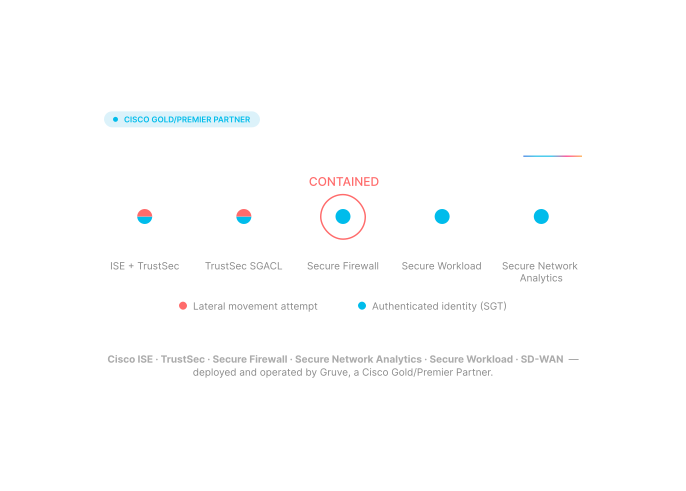
Identity, boundary, visibility, and workload enforcement under one policy model: ISE, TrustSec, Secure Firewall, Secure Network Analytics, Secure Workload, and SD-WAN.

Automated readiness

Our IDA readiness assessment turns manual segmentation discovery into a one-click report, mapping your network devices against the Cisco Group Based Policy matrix to show exactly what is ready to enforce.

Monitor before you enforce

Every engagement shows real traffic and simulates policy before anything is blocked. No guesswork, no surprise outages.

Identity, not addressing

SGT policy follows the user and the workload across campus, WAN, and data center, with no VLAN re-architecture and no re-IP.

Delivery plus operations

Professional services for the build, managed segmentation for the life of the estate, and Cisco Capital financing available for fixed-scope programs.

85%

Network segmentation

Challenge: flat, unsegmented network architecture

limit on breach propagation

500+

Deployments delivered across 100,000+ global locations.

FAQs

Frequently asked questions about
Cisco segmentation services

Do we have to re-IP or redesign our VLANs?

No. Security Group Tags are assigned at authentication and travel with the user or device, so policy is written against identity rather than subnet. That is the main reason TrustSec-based segmentation can be phased into an existing network instead of requiring a re-architecture.

What if some of our switches do not support TrustSec?

That is exactly what the readiness assessment establishes. The automated report maps your installed base against the Cisco Group Based Policy matrix and shows which platforms can enforce today, which need a software update, and which need to be sequenced into a refresh. Enforcement is phased around that reality, and boundary enforcement through Secure Firewall covers zones the fabric cannot yet enforce.

Should we start with the campus or the data center?

Most organizations start where the pressure is. If the driver is ransomware containment, IoT and OT exposure, or an ISE and firewall refresh already in flight, campus first. If the driver is a regulated application, PCI scope reduction, or crown jewel isolation, data center first. The policy model is shared either way, so neither path is wasted work.

Will enforcement break our applications?

Nothing is enforced until it has been observed. Secure Workload builds a dependency map from live telemetry and simulates policy against real traffic, and campus policy runs in monitor mode before SGACLs are enforced. The proof of value engagement exists specifically to prove this on your own environment.

What do we get to show auditors, insurers, and the board?

An SGT policy matrix that maps to Zero Trust control requirements, a blast-radius baseline from the assessment, and, under managed segmentation, monthly containment and compliance reporting. Segmentation also narrows audit scope by isolating cardholder and regulated environments from the rest of the estate.

Can you protect vulnerable devices before we finish patching?

In many cases, yes. Cisco Live Protect applies a vulnerability shield to a live system with no downtime and no switch reboot, so devices are protected during the window between disclosure and your planned patch. Shields are continuously re-validated and retire automatically once the underlying software is patched.

Get Started

Find out how far an attacker
could move today

Start with a segmentation readiness assessment, delivered jointly with Cisco.
You get a blast-radius baseline, an automated TrustSec readiness report, and a prioritized roadmap.

    Response within 24 hours · NDA available on request