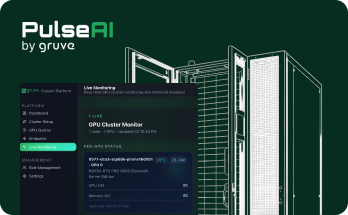
Just Launched Gruve PulseAI Platform, your private AI infrastructure, production-ready in under 2 weeks.PulseAI is live — private AI, ready in 2 weeks.

See PulseAI
Why Now

Annual validation can't
keep pace with how fast
readiness actually changes

Note: the following draws on public regulatory and threat-research
guidance (NIST, CISA, NYDFS, HHS, SEC, IBM, Google) to frame the
problem — not a claim about Gruve's own results. 

AI-accelerated attacks

Ransomware with data exfiltration, identity-centric compromise, and third-party disruption now create multi-front incidents that overwhelm plans built for simpler scenarios. 

NYDFS · HHS · SEC

Regulators expect a program, not a workshop. NYDFS, HHS, and SEC expectations increasingly call for organizations to train, drill, and update response plans on an ongoing basis — not just once a year. 

NIST · CISA

Guidance was written for programs, not events. NIST's test, training, and exercise guidance and CISA's after-action frameworks are both built around continuous improvement, not a single isolated session. ) 

The Gap

A completed exercise isn't
the same as a tested capability

One session proves a moment, not a program 

Plans change, leaders rotate, and third-party dependencies shift — a single tabletop can surface issues, but it can't prove they were closed or that new leaders understand their role. 

The plan and the room don't always match 

The real gap isn't the plan itself — it's the distance between what the plan says and what people actually do when they must declare, escalate, notify, and communicate at once. 

Boards and insurers expect proof over time 

They've moved past "did you run a tabletop?" — what they want now is evidence that remediation is tracked and readiness is maintained as an ongoing program. 

"A single exercise can surface a gap. Only a program can prove the gap stayed closed." 

Talk to an investigator
HOW THE ENGAGEMENT WORKS 

A repeatable four-phase model that
documents every decision

Phase 1

Pre-session intake 

Defines objectives, threat context, and regulatory drivers, and maps who owns declaration, escalation, legal engagement, and notification. Who's involved: CISO, IR lead, Legal, engagement lead. 

Phase 2

Scenario configuration 

Generates a scenario from client data, IR plan structure, and scenario modules, with injects mapped to specific cross-functional decisions. Who's involved: Engagement lead, facilitator. 

Phase 3

Live session 

A facilitator-led, time-compressed exercise where each inject requires a real decision, with behavior and gaps logged in real time. Who's involved: All participating functions. 

Phase 4

Post-session 

A structured After Action Report ties every finding to a specific inject, observed behavior, and decision outcome, plus a leadership readout. Who's involved: Engagement lead, CISO, executive sponsor. 

Solutions

Readiness becomes an operating rhythm
rather than an annual event

A recurring readiness program built around regular tabletop exercises, action tracking,
trend analysis, and leadership reporting — not a one-time workshop. 

Recurring assurance
cadence

Quarterly or semiannual readiness sessions that establish testing and updating response behavior as an operating rhythm, not an annual event. 

Scenario rotation and
modernization 

Scenarios refreshed to reflect current business realities, leadership priorities, third-party dependencies, and threat patterns, generated through a structured platform. 

Cross-functional
decision validation 

Tests how Security, IT, Legal, HR, Communications, and leadership make decisions, hand off information, and escalate — not just individual team performance. 

Action tracking
and closure review 

Tracks previously identified issues, validates remediation, and retests gaps, with findings tied to named owners and re-test checkpoints.

AI-assisted
trend analysis 

AI teammates accelerate consolidation of recurring observations, action themes, and reporting artifacts, while conclusions stay human-led.

Readiness
reporting 

A year-over-year view of readiness progress, risk movement, and remaining gaps, structured to support insurer, audit, and board conversations.

BENEFITS

Readiness you can show,
not just assert

Replaces one-time exercise evidence with an ongoing body of proof grounded in observed behavior and logged decisions. 

Shows leadership whether prior gaps were closed and whether readiness is trending in the right direction.  

Named owners for incident declaration, escalation, and notification, with defined thresholds for legal, insurer, and executive engagement.  

Brings new executives, legal leaders, and operational owners into a practiced response model before a live incident has to teach them their role.  

A defensible record of recurring validation and resilience improvement, structured for governance and insurance renewal conversations.  

Keeps the response model aligned to new threats, technology, vendors, and governance expectations instead of letting plans drift.  

DISTINCT SERVICE OFFERINGS 

Three ways to bring Gruve in

Quarterly

Quarterly readiness validation 

Recurring quarterly cadence focused on cross-functional incident-response readiness. 

  • Quarterly reports
  • Action tracker
  • Readiness trend summary
  • Decision logs 
Best for: CISOs · Risk leaders · IR owners 
Annual

Enterprise resilience validation program 

Ongoing subscription for governance-grade evidence of year-over-year readiness improvement. 

  • Annual resilience report
  • Trend analysis
  • Board/audit support package
  • AARs
Best for: Regulated enterprises · Boards · Audit and insurance stakeholders 
WHY GRUVE

A program, not a project 

Program,
not project 

A managed resilience program with repeatable cadence and evidence of improvement — not a one-time exercise.

Decision-
driven

Every inject forces a real decision with a named owner. No decision means a documented finding.

Cross-functional
by design 

Tests Legal, HR, Communications, and executive leadership alongside Security and IT.

Evidence-based
findings 

Every finding ties to a specific inject, an observed behavior, and a logged decision.

Platform-powered
repeatability 

Scenarios generated through a structured platform, keeping facilitators focused on decision quality.

AI-augmented,
human-led 

AI speeds up scenario variation and reporting; readiness judgments stay human-led throughout.

Closed-loop
remediation 

Findings link directly to remediation ownership and retesting, so organizations show progress, not just observations.

Governance-ready
output 

Concise, audit- and insurer-ready documentation reflecting recurring validation, not one-time activity.

Successful Stories

From episodic tabletops to
a durable readiness cadence

Multinational manufacturer 

The board wanted proof readiness was improving, not just another tabletop.

A multinational manufacturer needed more than an annual tabletop. The board wanted evidence that readiness was improving over time, and cyber-insurance renewal discussions required documented validation. Prior exercises were episodic — findings aged out, new leaders joined between sessions untested, and the response model drifted as vendors, cloud usage, and communications workflows changed. Gruve implemented a recurring validation program with quarterly scenario rotation across ransomware, third-party disruption, and executive decision-making, translating findings into named improvement actions tracked and retested across sessions. 
Key results
  • Established a quarterly readiness cadence aligned to audit and insurance milestones 
  • Linked findings to named owners with defined timeframes and re-test checkpoints 
  • Onboarded new leaders into a practiced response model before a live incident forced it 
  • Produced year-over-year evidence of readiness progress for executives, auditors, and insurers 

FAQs

Frequently asked questions about
Continuous incident response program validation

How is this different from our annual tabletop exercise? 

An annual tabletop proves a moment. This is a recurring program — scenario rotation, action tracking, and trend reporting that shows whether readiness is actually improving over time.

Does AI grade our performance or make readiness judgments? 

No. AI teammates accelerate scenario variation, trend summarization, and report drafting, but facilitators and DFIR leaders remain accountable for every readiness conclusion and recommendation.

Who needs to participate beyond Security and IT? 

Real incidents require Legal, HR, Communications, and executive leadership too — the program is built to test decisions and handoffs across all of these functions, not just the responder team.

Can this support our cyber-insurance renewal or audit requirements? 

Yes. Reporting is structured to give boards, auditors, and insurers a defensible, year-over-year record of recurring validation and remediation follow-through.

What happens to findings from previous sessions? 

They’re tracked to closure. Each engagement reviews previously identified gaps, validates whether remediation happened, and retests where needed — findings don’t just age out.

Get Started

Move beyond one-off exercises
and build a durable readiness rhythm

See how Gruve's Continuous Incident Response Program Validation helps your organization measure
improvement, prove readiness, and keep incident-response capability aligned to change. 

    Response within 24 hours · NDA available on request