2 paragraphs on what was at risk in the customer's business. Zero
product language. The specific reason this was hard for this buyer
(renewal window, sovereignty, legacy MSSP, cost per token).
Fails if generic.
global average cost of a data breach (IBM, 2025)
increase in attacks beginning with exploitation of public-facing applications (IBM X-Force, 2025)
fastest observed time from initial access to data exfiltration (Palo Alto Networks Unit 42, 2025)
Not a managed detection and response replacement — an assurance layer that recurringly
validates whether hidden compromise, risky behavior, or material drift exists in the
systems that matter most.
A structured schedule for compromise-oriented reviews of the systems, identities, workflows, and business changes most relevant to your evolving risk picture.
Focused assurance activity when meaningful change happens — platform migrations, executive turnover, layoffs, new AI deployments, or major vulnerability events.
Accelerates pattern grouping, issue trend analysis, and reporting support, while analysts verify what’s actually meaningful and action-worthy.
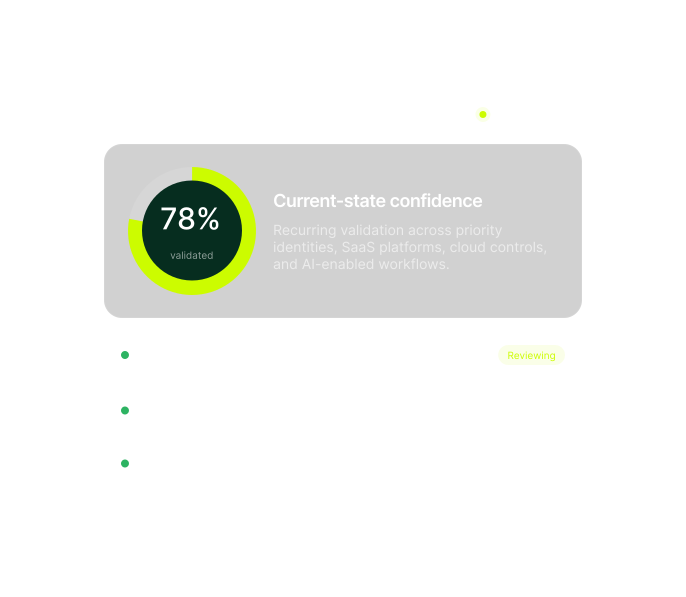
Shows leadership how risk is moving over time, what’s been remediated, where drift persists, and which themes need continued attention.
An established assurance relationship that can rapidly pivot into deeper validation, targeted hunting, or compromise investigation when a higher-risk event occurs.
Keeps leadership closer to the true risk picture instead of relying on aging point-in-time assessments.
Surfaces access sprawl, control degradation, and emerging assurance gaps before they become larger incidents.
Focuses high-value validation on material changes and risk-relevant systems, instead of building a full internal hunting function.
Provides recurring evidence that security is actively validated over time, not just asserted.
Connects one-off assessments, remediation programs, and incident-driven work into one consistent assurance operating model.
A recurring validation cadence for priority systems, identities, and workflows where point-in-time reviews are no longer sufficient.
Adds deeper hunt cycles and change-triggered reviews across hybrid endpoint, identity, SaaS, cloud, and AI-adjacent environments.
A higher-touch cadence for organizations with executive, regulated, or high-consequence environments that require discreet, defensible ongoing validation.
The service is built to validate risk over time, not merely triage events as they arrive.
Combines recurring sweeps, targeted hunts, and change-triggered validation inside a single program.
AI accelerates trend analysis and reporting, while findings and judgments stay analyst-owned.
Acts as an ongoing bridge between preparation, validation, response readiness, and resilience improvement.
No. The focus isn’t triaging alerts 24×7 — it’s validating whether hidden compromise, risky behavior, or material control drift exists over time, and turning that into a leadership-usable risk narrative.
Meaningful change — platform migrations, executive turnover, layoffs, new AI deployments, or major vulnerability events — can all trigger focused assurance activity outside the standard cadence.
No. AI teammates help prioritize candidate issues, summarize recurring patterns, and accelerate reporting, but all findings and conclusions remain analyst-validated.
Yes. The subscription includes flexible surge support, so the existing assurance relationship can pivot quickly into deeper validation, targeted hunting, or compromise investigation.
Recurring assurance reports, a trend view, an open-risk register, and prioritized actions — a defensible, evidence-backed record rather than a point-in-time claim.
See how Gruve's Continuous Assurance Monitoring helps your team validate hidden
risk over time, reduce drift, and brief stakeholders with evidence-backed confidence.