Check all thoughts
Blog
Regulatory intelligence vs rule engines: the evolution of compliance systems

Regulatory requirements have undergone fundamental changes in recent times. It will not be an exaggeration to claim that modern business leaders are facing a daunting regulatory environment. Global markets are becoming increasingly interconnected every day. This connection brings a massive wave of new rules. Traditional methods of managing these rules no longer work well. Many companies still rely on manual tracking or simple software. These tools fail when the pace of change increases. It is crucial for industry leaders to understand how technology is shifting to stay ahead.
This blog explores two critical tools in the compliance world. We will look at rule engines and regulatory intelligence. Each serves a unique purpose in an organization. Understanding their differences helps you build a resilient business.
Why Compliance Systems Are Being Rebuilt Right Now
Regulation is expanding across every sector, and the pace of change has also increased. Compliance teams must handle more updates across more jurisdictions. The new demand creates heavy operational strain. Organizations cannot rely on old compliance methods anymore. Three forces drive transformation: expanding regulation outpaces teams’ ability to process it, static frameworks cannot handle dynamic risk, and manual oversight misses critical changes.
The Volume and Velocity Problem of Regulation
Regulatory requirements grow in volume, complexity, and pace across multiple jurisdictions. KPMG research shows AI adoption jumped from 41 percent to 56 percent in one year. This increase has created an operational burden as teams struggle to track changes. Organizations face penalties for missing deadlines. Traditional quarterly reviews guarantee failure today.
Reactive Compliance Versus Proactive Compliance
IBM research identifies the core problem: the pace of change has outgrown static frameworks. Legacy systems rely on siloed processes and spreadsheets. This fragmentation creates duplicated efforts and slow responses. Without real-time insight, organizations react after problems emerge. The shift from reactive to proactive compliance requires automation and continuous monitoring.
What Is a Rule Engine and What It Does Well
Rule engines remain essential in compliance systems as they provide structured decision logic. They help firms apply consistent controls across processes, automating business decisions through consistent logic. When rules are clear, engines deliver speed and accuracy.
Defining Business Rule Engines and Decision Engines
Business rules shape organizational operations. Traditional programming languages require programmers to implement them. Rule engines are decision management inference engines providing low-code environments. Users create and modify business rules without writing code or restarting applications. For example, Azure Logic Apps Rule Engine integrates readable, declarative rules operating on multiple data sources.
Where Rule Engines Win
Rule engines excel in enforcement. They enforce policies identically across thousands of transactions, automating routine tasks like customer checks and transaction screening. They apply the same logic every time, supporting fairness and control. In financial services, this can support eligibility checks, while in compliance, it can support KYC and approval workflows.
Microsoft research emphasizes their reliability and predictability. In a probabilistic AI world, rule engines provide certainty. They create clear audit trails linking every decision to specific rules.
Where Rule Engines Struggle
Rule engines require constant upkeep. Regulations are not static. They keep changing. Each change can require rule edits, testing, and deployment. Rule engines break when regulations change frequently. Each update requires manual intervention, hand-coding, and testing. Organizations accumulate hundreds of rules, creating a maintenance burden. When regulations shift daily, rule engines lag behind. They excel at stable policies but fail when the rulebook itself keeps changing.
What Is Regulatory Intelligence and How Does It Differ
Regulatory intelligence is a structured process. It includes monitoring regulatory sources, interpreting updates, and translating them into organizational action. The PDA framework describes regulatory intelligence as a discipline that supports surveillance, interpretation, and informed compliance decisions.
Regulatory Surveillance to Interpretation to Actionability
Regulatory intelligence follows three stages: surveillance, which monitors regulatory sources continuously; interpretation, which analyzes changes and determines operational impacts; and actionability, which translates findings into assigned tasks and workflows. This framework provides context and priority beyond simple monitoring.
Automated Regulatory Intelligence Workflow
Automated systems ingest data from multiple sources continuously. Machine learning classifies changes by topic and urgency. Impact mapping compares new requirements against existing policies, identifying gaps and affected units. Workflow triggers create tasks automatically, notify stakeholders, and set deadlines, reducing manual effort dramatically.
What Intelligence Adds Beyond Rules
Intelligence systems detect change automatically by scanning thousands of sources daily. Prioritization ranks items by risk and timeline, so teams allocate resources efficiently. Evidence linking traces every obligation back to the source text, creating defensible compliance that regulators can easily verify. It supports prioritization based on risk and relevance.
Rule engines do not provide this sensing layer. They enforce rules after humans define them, whereas regulatory intelligence supports earlier insight.
It also strengthens defensible compliance. By linking decisions back to regulatory sources, firms gain stronger evidence.
Regulatory Intelligence Versus Rule Engines: A Practical Comparison
It is helpful to compare these two systems directly. They handle different parts of the compliance journey: A rule engine is your “execution” layer, while regulatory intelligence is your “sensing” layer. One acts while the other thinks. Most large firms now realize they need both to succeed.
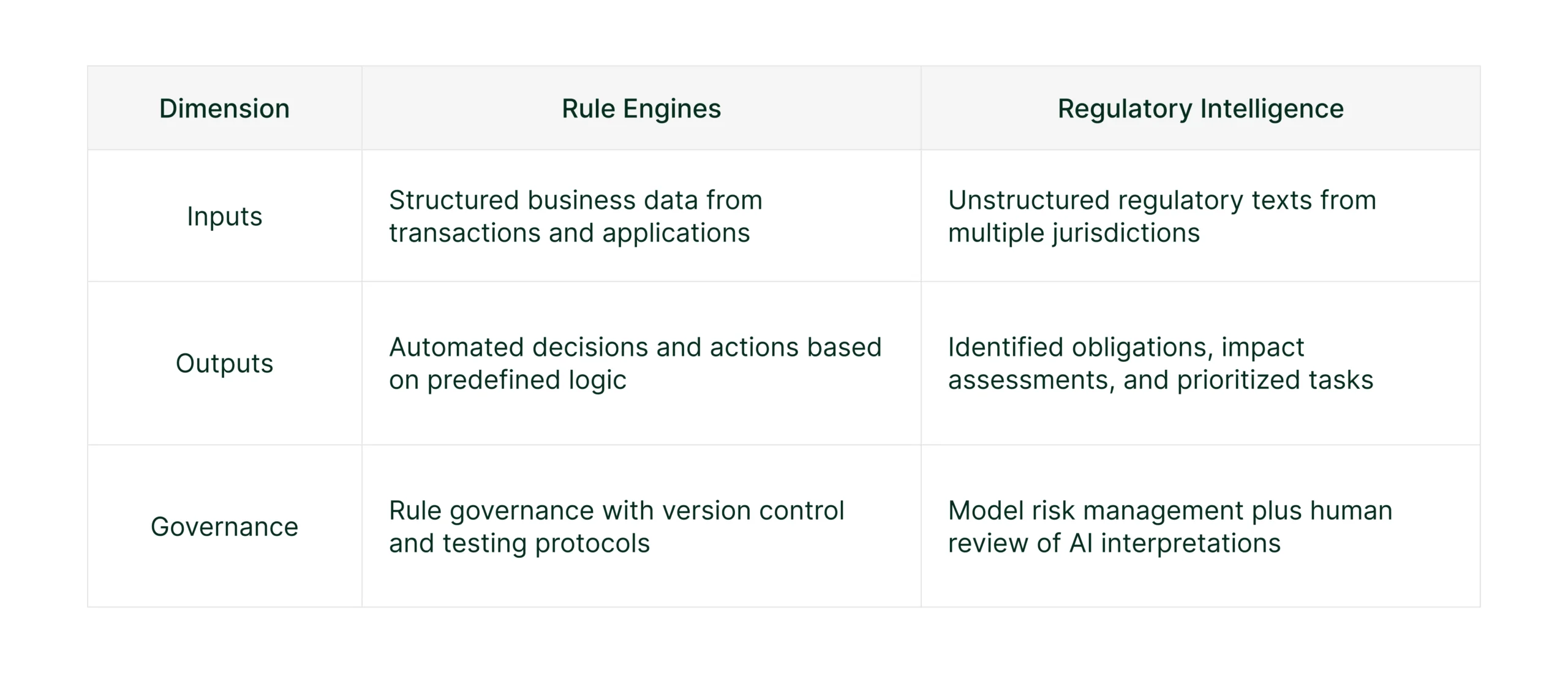
Inputs: Regulatory Texts vs Structured Business Data
Rule engines require clean and structured data to work. They need numbers and categories that fit into a table. On the contrary, regulatory intelligence works with messy and unstructured
text. It reads long legal PDFs and government notices, finding the meaning in the words before any data is created. This difference is fundamental to how they operate.
Outputs: Obligations and Impacts vs Decisions and Actions
The output of a rule engine is a final decision. It says “Yes” or “No” to a loan application. The output of regulatory intelligence is a list of obligations. For example, it can say, “You must change your data storage policy by June.” It identifies the impact on your current business model but does not make the final decision for you. Instead, it prepares you to make the right decision.
Governance: Model Risk and Human Review vs Rule Governance
Microsoft emphasizes the need for strong governance in rule engines. You must manage the risk of your logic models, which involves rigorous testing and version control. Regulatory intelligence requires human-in-the-loop review. Experts must verify the AI’s interpretation of a new law. Both systems need a clear chain of command. You must know who approved each rule or interpretation.
The Evolution: From Rules-Only to Hybrid Intelligence and Execution
Compliance systems are evolving toward hybrid models. Execution alone is not enough. Intelligence alone is also incomplete. A modern compliance automation stack needs both layers. Regulatory intelligence detects and interprets change, whereas rule engines translate policy into enforceable logic. The future lies in combining both.
KPMG emphasizes that AI will reshape compliance by improving scalability and responsiveness. This supports the move toward integrated compliance transformation.
Implementation Playbook: How Leaders Modernize Compliance Systems
Modernizing your system requires a clear plan. You cannot change everything overnight. Start by looking at your most painful manual processes. Focus on areas where laws change the most. This usually provides the fastest return on your investment. Modernization starts with clarity. Leaders should map how regulatory change becomes operational policy.
Start with the Reg Change to Policy Update Lifecycle
Begin by automating the link between laws and policies. It is non-negotiable to focus on the “reg change” lifecycle. Track how a new law moves through your company and ensure that a change in the law triggers an update in your internal manual. This prevents your policies from becoming outdated, keeping your staff working on the most current information.
Design for Auditability and Safe AI Use
Safety is critical when using AI for compliance. It is recommended to keep humans in the loop at all times. Use AI to do the heavy lifting of reading documents. Let your legal experts make the final call on the meaning. Maintain clear traceability from the law to the business rule. This creates guardrails that protect your firm from AI errors.
Key Performance Indicators (KPIs)
You must measure the success of your new system. Track the time it takes to interpret a new regulation. Measure how quickly you can update your internal rules. Look at the number of exceptions or errors in your process. High testing coverage is also a vital metric. These KPIs show the value of your investment to the board. They prove that your compliance function is becoming an asset.
Conclusion: Choosing the Right System for 2026 and Beyond
Compliance is no longer about static rulebooks. It is about speed, evidence, and resilience.
Rule engines provide execution and determinism. They enforce consistent outcomes through structured decision logic. Regulatory intelligence provides change sensing and prioritization. It helps firms interpret evolving obligations with discipline and context.
The strongest path forward is hybrid compliance automation. Leaders should invest in systems that detect change early and enforce policy reliably.